
Somewhere in your phone is a message that says “bins tonight?” It got a thumbs-up. Then life happened, the chat filled up with school reminders and memes, and the bins stayed right where they were.
Group chats are great for plans, jokes, and “where are the scissors?” They are not great as a chore list. The kitchen counter rule is simple: if the whole household needs to see it, put it where people already walk—not buried in a conversation nobody wants to dig through.
A shared list on the counter (paper, whiteboard, or a tablet on a stand) turns chores into something you can glance at while the kettle boils. You do not need a fancy setup. You need one place that does not scroll away.
Why chat threads fail as chore charts
Chat feels easy because everyone already has the app. The trouble starts as soon as the next message lands.
Chores in a group chat usually fall apart for the same reasons:
- They get buried. Dinner plans, parcel codes, and “who moved my charger?” push the bins reminder out of sight by lunchtime.
- A thumbs-up is not the same as done. Saying “on it” is easy. Emptying the dishwasher is the actual job.
- Nobody knows what is true right now. Was the recycling done, or was that last week’s “on it”?
- One person ends up chasing everyone. The adult (or flatmate holding the mental load) sends the same line again until everyone feels grumpy.
- Scrolling is work. Asking a tired kid or roommate to hunt through Tuesday’s chat is a good way to start a new argument about phones.
Spoken reminders have the same problem: they vanish when the conversation ends. A list that lives only in one person’s head is not a household plan. It is one tired person trying to remember everything for everyone.
If that sounds familiar, you are not failing at family life. You are using the wrong place for a shared job.
The kitchen counter rule, in plain English
Pick a spot your household naturally passes every day. Kitchen counters win often because mornings and evenings already happen there. Fridge doors, hall tables near shoes, and a shared desk in a flat all count.
Then make one rule:
Chores that belong to everyone live on the shared list. Chat is for talking. The list is for doing.
That does not mean you ban helpful messages. “I’m running late—can you start the pasta water?” still belongs in chat. What belongs on the counter is the steady stuff: wipe the table, pack bags, feed the pet, take out the recycling, tidy the living-room floor.
The counter list should be:
- Visible without unlocking a phone
- Up to date enough that people trust it
- Clear enough that “done” is obvious
- Shared so one person is not the only one who “knows”
When someone asks “did anyone do the bins?”, you point at the list instead of scrolling back through old messages.
A list people walk past beats a reminder people have to go hunting for.
Paper, whiteboard, or tablet—what matters is “shared”
The format matters less than the place.
| Setup | Best when… | Watch-outs |
|---|---|---|
| Paper list or sticky notes | You want something simple, fast | It goes stale; pens wander off |
| Whiteboard | You like big writing and easy wipe-downs | Needs a weekly tidy so it stays readable |
| Shared tablet | You want faces, live check-offs, and fewer reprints | Needs a home on the counter, not lost in a bag |
Many families keep a simple paper chart for years and love it. Others prefer a live list because checking something off feels clearer than crossing out lines until the page looks messy. Our take on chore charts vs. a live scoreboard walks through that choice without picking a winner for every home.
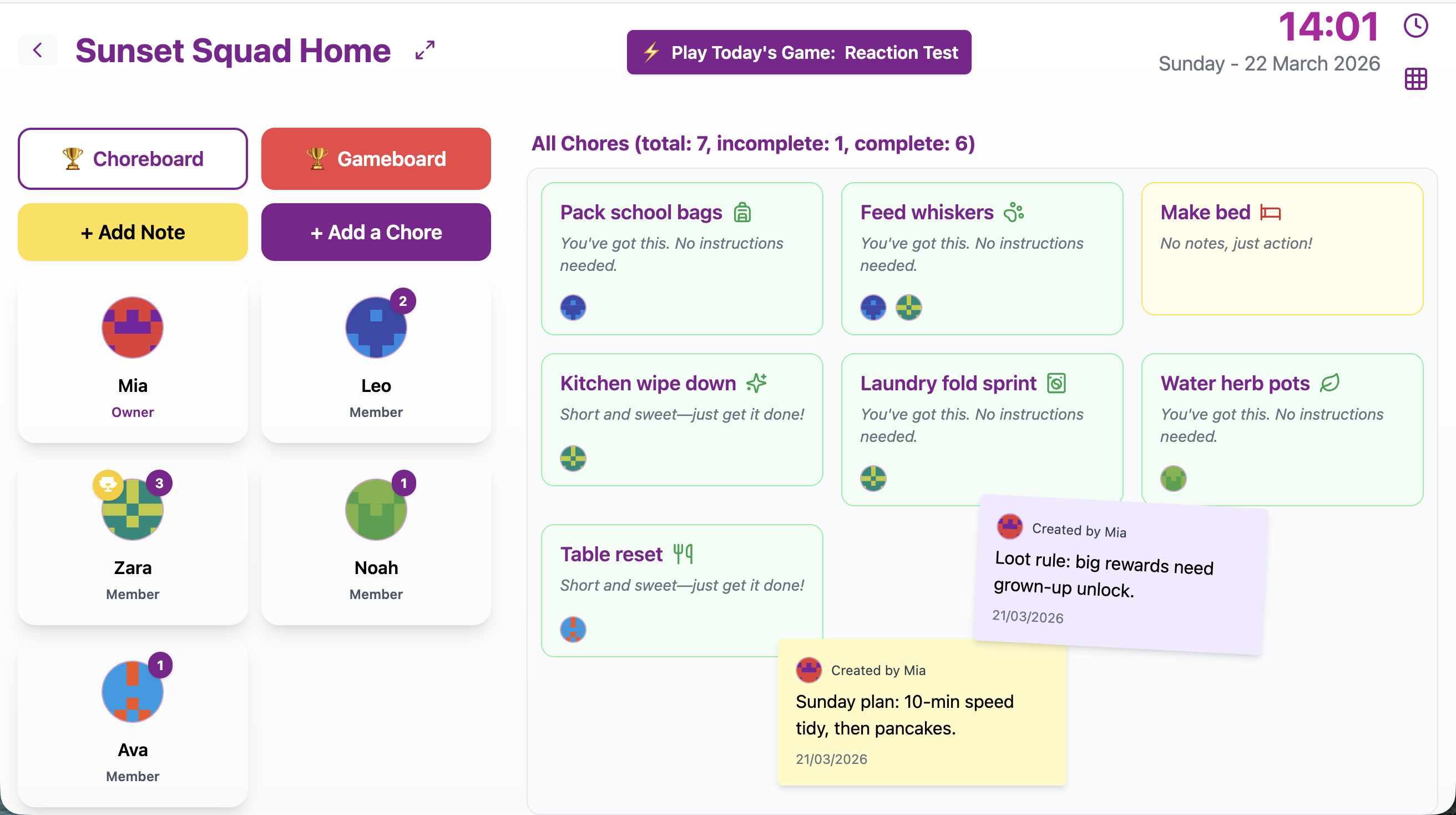
If you try Chorish, the home can sit on a kitchen tablet with chores, sticky notes, and member faces in one place—free, no sign-up, and private on your devices. The tool is optional. The rule is not: shared space beats buried chat.
A week of trading chat for the counter
You do not need a big household overhaul. Try this for seven days.
- Choose five regular chores that currently live in your head or in chat.
- Put them on the counter list where breakfast already happens.
- Make each job clear. “Kitchen” becomes “wipe the counters” or “empty the dishwasher.”
- Agree on one check moment—after dinner, before screens, or while coffee brews.
- Use chat for exceptions only. “I’ll do bins tomorrow—I’m out tonight” is fine. “Bins???” on loop usually means the list is not being used.
- Mark done where everyone can see it. A tick, a wipe, a tap—whatever your setup allows.
- Review once at the weekend. Drop what nobody does. Add what keeps getting forgotten.
If mornings are the chaotic hour, pair the counter list with a short morning routine. If evenings are when mess piles up, an evening reset plus a glance at the board can close the day without a lecture.
What to say instead of another ping
How you ask matters almost as much as where the list lives.
Try swapping:
- “I already told you in the chat.”
- “Why is nobody helping?”
- “Did you even see my message?”
For:
- “Check the board—bins are still open.”
- “One job from the counter list, then screens.”
- “Let’s update the list so we stop guessing.”
Pointing at a shared list feels less personal than pointing at someone’s character. That is the same idea as making chores visible without nagging: the reminder is about the list, not a lecture.
Roommates get the same benefit. Flat chats fill up with “anyone need anything from the shop?” faster than a chore list can survive. A counter tablet or whiteboard in the kitchen keeps things fair without turning every evening into a meeting. For more on fairness without fake perfect equality, see how to make chores feel fair.
Sticky notes still have a job
Not everything belongs on the permanent chore list. “Dentist Thursday” or “spare key under the plant” can live on a sticky note next to the board. The kitchen counter rule is not anti-notes. It is anti-losing the weekly basics inside a pile of unrelated chat.
A shared home on a tablet can hold both: the steady chore list and a couple of colourful reminders that would otherwise vanish into a thread. Paper homes can do the same with a whiteboard plus stickies. Either way, the counter stays the place everyone checks.
When chat is still the right tool
Keep chat for:
- Quick swaps (“Can you grab milk?”)
- Kindness (“Thanks for covering bedtime”)
- One-off plans that are not a regular chore
- Celebrations (“Bins hero of the week”)
Do not keep chat for:
- The only copy of the weekly list
- Proof that someone “should have known”
- A score only one person keeps by re-sending messages
If your household needs a calmer weekly check-in, a short family reset without a lecture beats a Sunday night essay in the group chat.
How you know it is working
You will know the kitchen counter rule is helping when:
- People check the list without being called over.
- “Did anyone…?” happens less often.
- It is obvious what is done and what is not.
- One adult’s phone is no longer the household’s only chore brain.
- Arguments shrink from “you never listen” to “oh—still on the board.”
That is not a personality change. It is a clearer place for the work. When chores are easy to see, there is less need to nag.
A two-minute job still counts when it is on the shared list—see why a two-minute chore still counts if perfectionism is sneaking in. And if the whole habit fell apart after holidays or illness, restart kindly with how to restart chore habits instead of launching a new group chat called “CHORES SERIOUSLY THIS TIME.”
Try the counter this week
Clear a little space on the counter. Put five real chores there. Tell the household the new deal: chat for talk, counter for chores. Give it a week. Adjust the list. Keep the location.
If you want a free way to try that shared view—avatars, sticky notes, a Choreboard, optional daily games, no account to create—open Chorish on a tablet and leave it where the kettle lives. Questions about privacy, homes, or how it fits a family or flat? The FAQ is there when you need it.
The bins will still get forgotten sometimes. But at least everyone will know where to look.