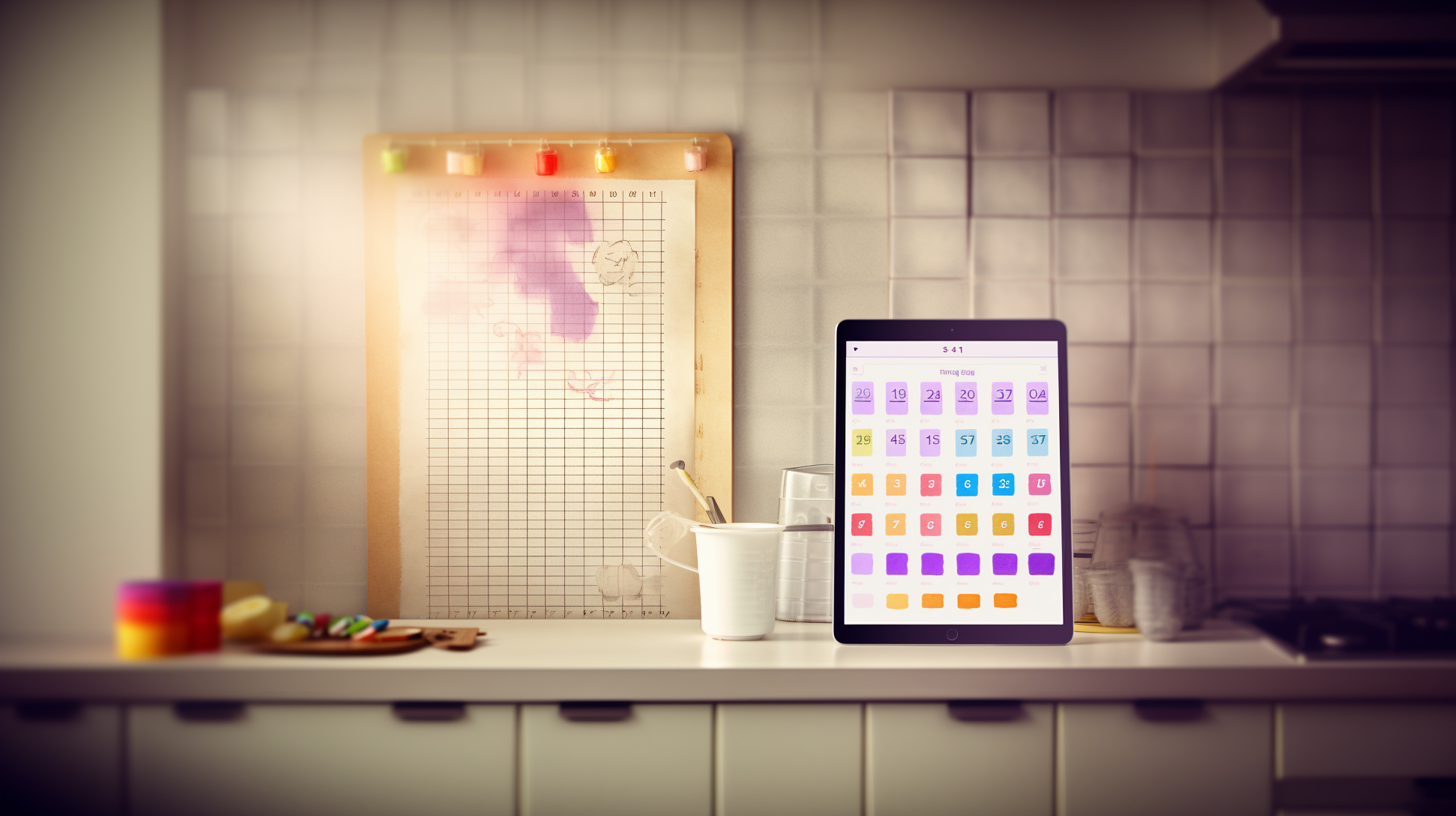
Every family has tried some version of the chore chart. A neat grid on the fridge. A row of stickers. A laminated sheet with a marker tied to it by string, because optimism is a powerful thing.
And for a few days, it works beautifully.
Then real life wanders in wearing muddy shoes. Someone forgets to tick a box. Someone else insists they definitely did feed the pet, even though the pet is staring dramatically at an empty bowl. The chart slowly becomes part of the scenery, right next to the takeaway menu and the dentist appointment card from three months ago.
That does not mean chore charts are bad. They can be a great starting point. But if your goal is to help kids actually pitch in without turning every evening into a tiny courtroom drama, a visible, live scoreboard can do something a paper chart often struggles with: keep the whole household gently aware of what is happening now.
Let us compare the two, without throwing your beloved sticker sheet under the bus.
What paper chore charts do well
Paper charts are popular for good reasons. They are simple, cheap, and easy to understand. A child can glance at a list and see that “put shoes away” or “clear plate” is part of the day. For younger kids especially, that kind of predictable visual cue can be helpful.
A good paper chart can:
- Make expectations visible
- Give kids a satisfying way to mark something done
- Create routine around repeated tasks
- Help parents avoid repeating the same instructions quite so often
- Add a little reward or recognition through stickers, stars, or checkmarks
If your family loves a fridge chart and everyone uses it happily, excellent. Please continue. The fridge has earned its moment.
The trouble starts when the chart becomes static. A set-and-forget list can fade into the background. It may show what should happen, but not always what has happened, who is currently helping, or how the household is doing as a team.
That is where a live scoreboard has an edge.
The problem with “set and forget”
Most chore systems do not fail because the chart was ugly or the marker was the wrong colour. They fail because the system stops being part of daily life.
Here is the common pattern:
- The chart is exciting on Monday.
- By Wednesday, someone forgot to update it.
- By Friday, nobody trusts it.
- By Sunday, a parent is mentally keeping score anyway.
At that point, the chore chart has become decoration. Worse, it may create more friction because the family now has two systems: the chart on the wall and the invisible list in a grown-up’s head.
Kids notice this. If the chart is not current, it becomes easier to ignore. If nobody looks at it together, it loses its power. If the only time it comes up is during a reminder, it starts to feel like nagging with boxes.
The fix is not necessarily a more complicated chart. Often, it is a more alive one.
Why a live scoreboard feels different
A live scoreboard is not just a list of chores. It is a shared snapshot of progress. Everyone can see who has pitched in, what has been completed, and where the household energy is going.
That visibility matters because kids often respond better to clear feedback than vague reminders. “Can someone tidy up?” is easy to dodge. “The board shows Mia has done two jobs and Sam has done one - who wants to grab the next quick win?” is easier to act on.
The tone matters, of course. A scoreboard should not become a family shame machine. Nobody needs a dramatic scoreboard ceremony because someone forgot the dishwasher. But when handled lightly, visible progress can turn chores from a hidden obligation into a shared game of “let’s keep the house moving.”
The format can be simple: a whiteboard, a magnetic chart, a tablet on the counter, or a shared choreboard app. The important part is that the information is not buried in one person’s phone or memory. It is there for the household to see.
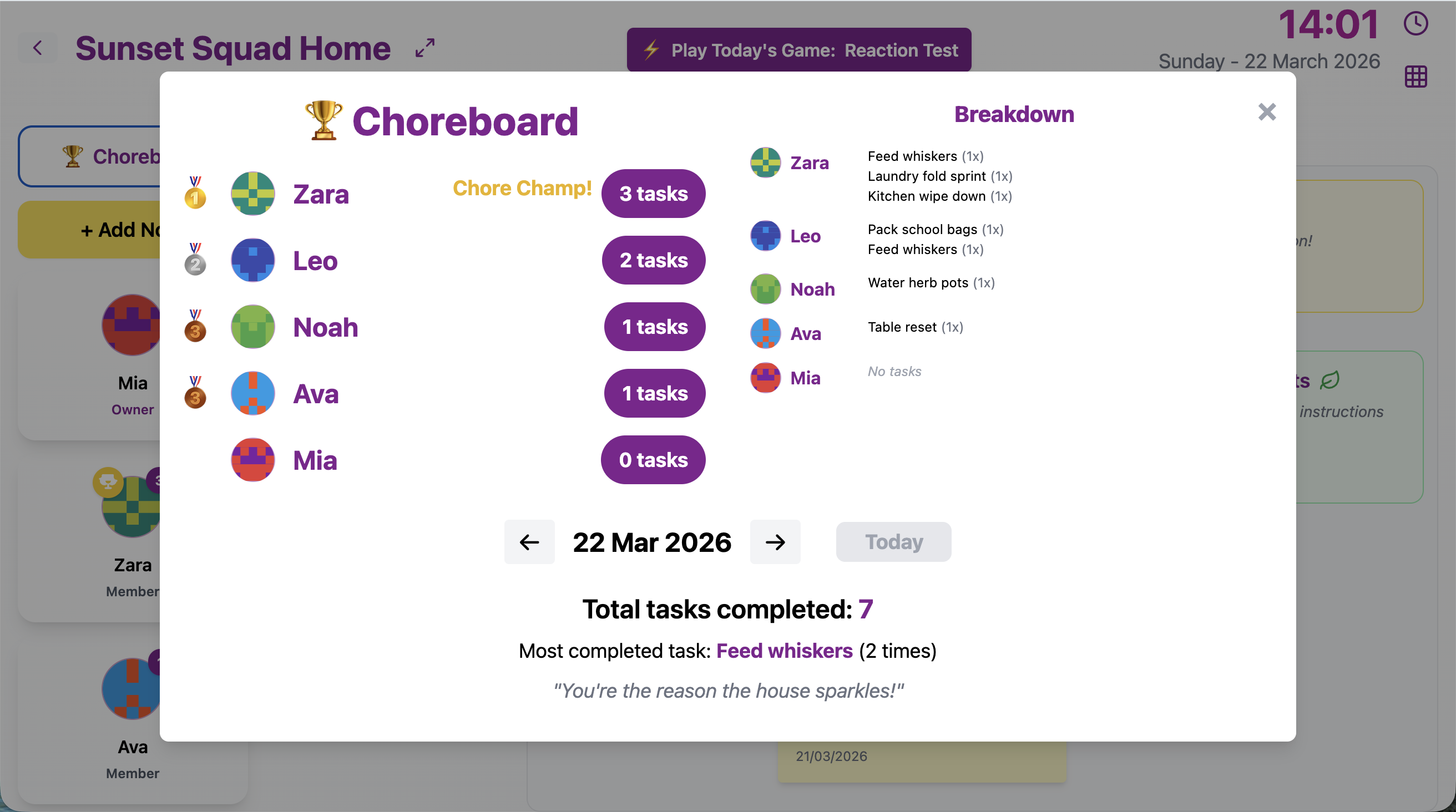
A shared Choreboard turns “who did what?” into something everyone can see at a glance.
Kids need feedback, not a lecture
One reason live systems work well is that they give feedback without requiring a speech.
When a child taps a chore done and sees their progress reflected, the system quietly says, “That counted.” For many kids, that is more motivating than a long reminder about responsibility, teamwork, and why socks do not belong in the fruit bowl.
Good feedback is:
- Immediate: The task is marked when it happens.
- Visible: Everyone can see the update.
- Low drama: No grand announcement required.
- Positive: Progress is noticed without making perfection the goal.
This is especially useful for families trying to build better chore routines for kids. The habit grows when the action and the recognition sit close together.
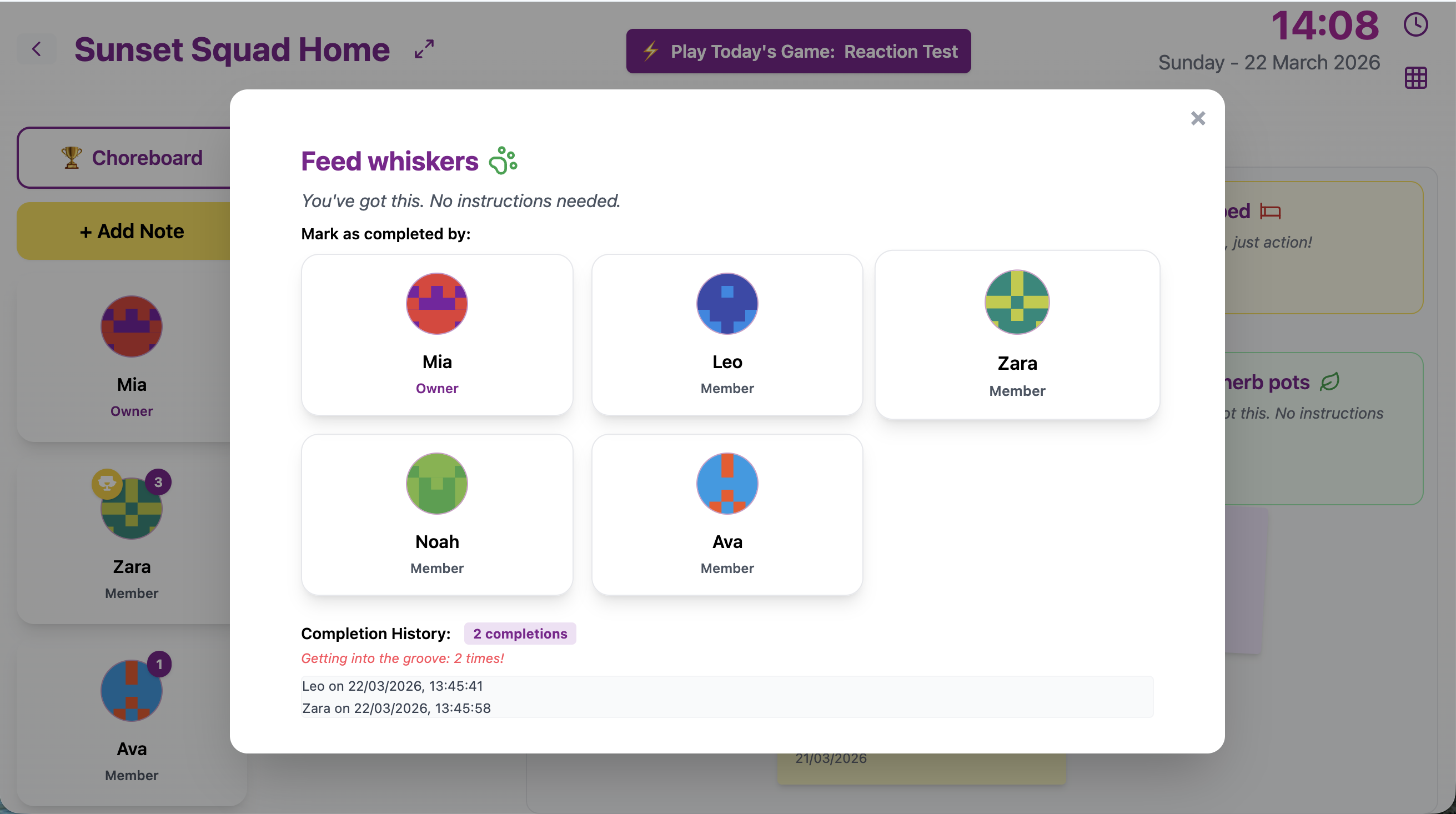
A quick tap can make completion feel clear without turning the moment into a meeting.
The gold medal effect
Small rewards can be surprisingly powerful when they are playful and not too serious. A gold medal on a scoreboard is not a life verdict. It is a little sparkle that says, “Nice work, helper.”
That tiny bit of recognition can help kids who need a reason to start. It can also help adults remember to notice effort instead of only spotting what is unfinished.
The trick is to keep competition friendly. Try language like:
- “Who wants to climb the board today?”
- “Looks like we are nearly caught up.”
- “That was a strong laundry comeback.”
- “Gold medal energy from the person who cleared the table.”
Avoid language that compares character or worth:
- “Why are you always last?”
- “Your sister is better at chores.”
- “You never help unless there is a prize.”
The scoreboard should make effort visible, not turn siblings into tiny performance reviews. For more on keeping the fun balanced, our post on why Chorish makes chores fun for the whole family walks through that playful spirit.
Paper chart vs. live scoreboard: a practical comparison
Both approaches can work. The best choice depends on your family’s habits, ages, and tolerance for lost pens.
| Chore system | Best for | Watch out for |
|---|---|---|
| Paper chore chart | Simple routines, younger kids, quick visual reminders | Can become outdated or ignored if nobody updates it |
| Sticker chart | Short-term motivation and visible rewards | Stickers can become the whole point if the routine is not reinforced |
| Parent-managed list | Busy weeks when one adult coordinates everything | Kids may not see the full picture or learn to check for themselves |
| Live family scoreboard | Shared spaces, multiple helpers, friendly motivation | Needs a kind tone so competition stays light |
You do not have to pick one forever. Some households use a paper list for weekly expectations and a live scoreboard for actual completed chores. That combination can work nicely: the chart says what matters, the board shows what happened.
Put the list where family life happens
One of the biggest chore-system upgrades is not fancy. It is location.
A chore list hidden inside a parent’s phone is easy to forget because nobody else sees it. A paper chart in a hallway nobody uses is also easy to ignore. The best chore systems live where family life already happens: the kitchen counter, breakfast table, hallway by the school bags, or another shared spot people naturally pass.
That is why tablets can be useful for household chore tracking. Not because families need another screen shouting for attention, but because a shared device can act like a modern fridge chart: visible, touch-friendly, and easy to update.
If you use a digital board, keep it calm and obvious. A shared dashboard, clear names or avatars, and simple chore icons are usually enough. The goal is not to build a command centre; it is to make the next useful action easy to spot.
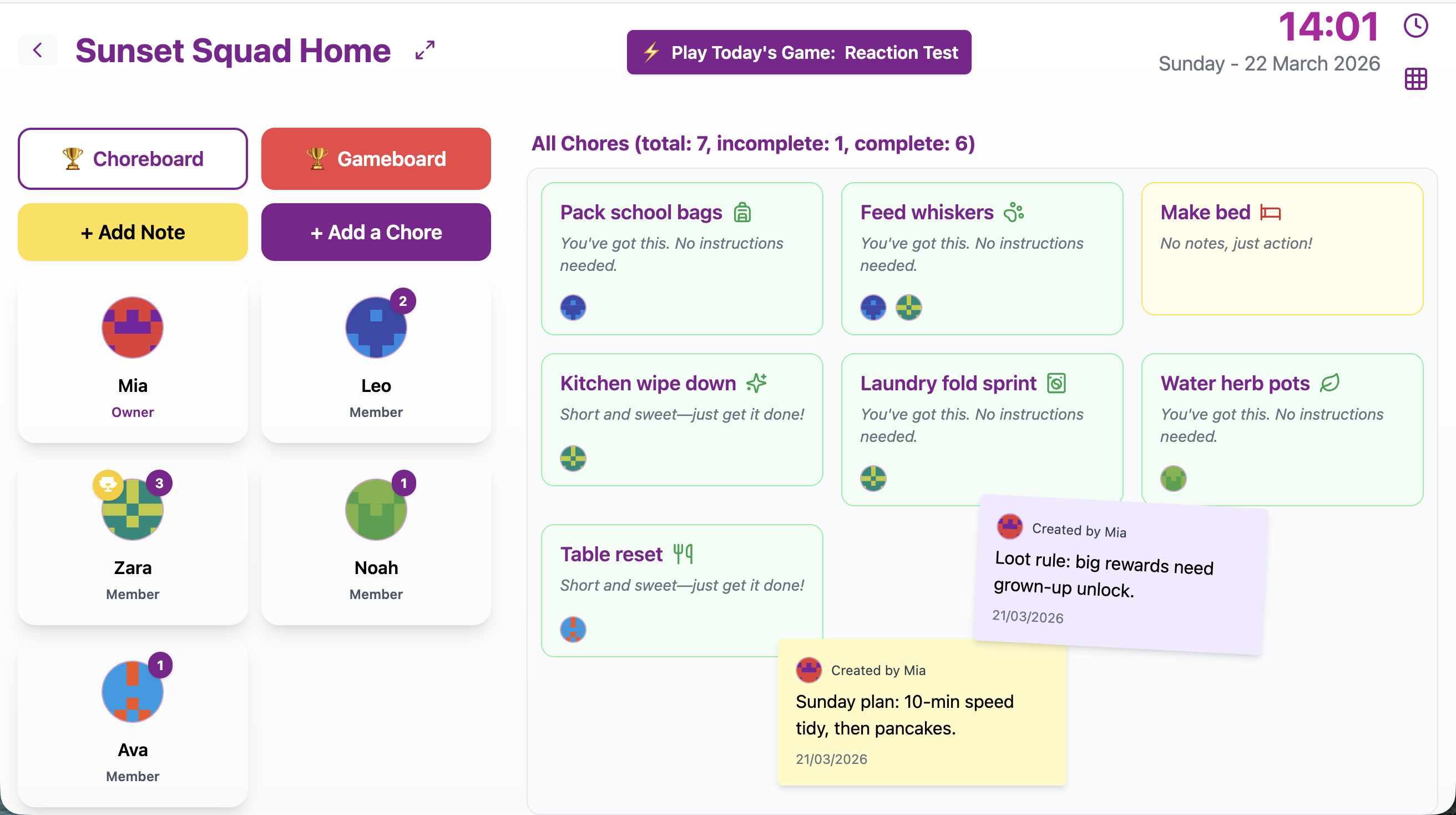
A visible home screen helps chores stay part of the room, not just part of a parent’s memory.
How to introduce a scoreboard without making it intense
If your family has never used a scoreboard-style chore system, start gently. The goal is not to launch “Household Olympics: Bin Night Edition.” The goal is to make helping easier to notice.
Try this:
- Pick a small set of chores first. Start with tasks that happen often: clearing plates, feeding a pet, putting shoes away, wiping the table, or loading the dishwasher.
- Explain the board as a shared helper. Try: “This helps us see what has been done so I do not have to keep asking.”
- Praise visible effort. Notice the tap, the attempt, and the follow-through.
- Keep the first week low stakes. No lectures if people forget. Just reset and keep going.
- Review together. Once a week, ask what felt fair, what was annoying, and what should change.
That last step matters. Kids are more likely to buy into a system when they have some say in it. Maybe one chore is too vague. Maybe one task needs splitting into smaller steps. Maybe the family discovers that “clean your room” is not a chore, it is a mysterious multi-day expedition.
What should actually go on the board?
One easy mistake is adding every possible household task until the board looks like it is managing a small hotel. A useful family scoreboard should focus on jobs that are visible, repeatable, and clear enough for someone to finish without a debate.
Good starter chores include:
- Putting shoes, bags, or coats where they belong
- Clearing plates after meals
- Feeding a pet with adult guidance where needed
- Wiping the table or counter after snack time
- Sorting clean socks or folding simple laundry
- Taking recycling to the right bin
Vague chores need a little translation. “Help downstairs” might become “put cushions back, clear cups, and place toys in the basket.” “Tidy your room” might become three smaller steps: laundry in the basket, books on the shelf, floor clear enough to walk across without discovering a lost spoon.
That kind of detail is not fussy. It is kind. Kids can pitch in more confidently when the finish line is visible.
A few examples by household rhythm
The same scoreboard idea can look different depending on when your home gets chaotic.
Morning rush: Keep it tiny. Shoes away, breakfast plate cleared, school bag by the door. Morning boards should reduce shouting, not introduce a ten-step quest before 8 a.m.
After school: Use a short reset before screens or clubs: lunchbox emptied, shoes put away, one shared-area job. If energy is low, pick chores that take two minutes and feel clearly complete.
Evening reset: This is where a scoreboard can shine. Set the table, clear the table, load or unload the dishwasher, wipe surfaces, put living-room clutter back. A shared board helps everyone see that bedtime calm is a team sport, not one adult doing a dramatic solo performance.
Weekend catch-up: Save bigger jobs for when nobody is racing the clock. Laundry sorting, bins, plant watering, vacuuming one room, or resetting the entryway can all work well when the household has a little more breathing room.
What actually gets kids to pitch in?
There is no magic button, sadly. If there were, someone would have taped it to every laundry basket in the country by now.
But a few patterns help:
- Clarity: Kids need to know what “done” means.
- Visibility: The list should be easy to find and check.
- Recognition: Effort should be noticed quickly.
- Fairness: Everyone should see that chores are shared.
- Small starts: Tiny jobs build momentum better than giant vague ones.
- A little fun: Playfulness can reduce resistance.
Chore charts handle some of this. A live scoreboard handles more of it, especially in busy households where three people are moving in different directions and nobody remembers who last emptied the dishwasher.
If you want more practical ideas, start with 5 ways Chorish turns chore chaos into family fun and why a quick game after a chore is a break, not a distraction. A tiny moment of fun can help the next chore feel less like a punishment and more like part of the rhythm.
A simple reset for this week
If your current chore chart has become fridge wallpaper, do not throw the whole idea away. Try this reset:
- Choose five chores that actually matter this week.
- Put them somewhere everyone can see.
- Make the “done” action obvious.
- Check progress together for two minutes at the same time each day.
- Celebrate effort, not perfection.
That is it. No family constitution required.
If you prefer a digital version of that shared board, Chorish is one free option built around visible household chores, friendly progress, and quick playful breaks. A paper chart, whiteboard, or tablet can all work; the real win is choosing a system your family will actually notice and update.
Questions about Chorish are covered in the FAQ. And if you are building chores around different ages and stages, our guide to age-appropriate chores for kids pairs nicely with this one.