
Every family chore routine falls apart sometimes.
Maybe it was a holiday. Maybe everyone got ill. Maybe school ended, work got busy, a house move happened, or the usual rhythm disappeared under a pile of sports kits, late dinners, and mystery paperwork.
One week you have a perfectly reasonable chore system. The next week the system is somewhere under the laundry, making no attempt to rescue itself.
That does not mean you failed.
It means life happened.
The useful question is not “How did we let this happen?” The useful question is “What is the smallest way to restart?”
Restarting chore habits after life gets messy should feel calm, practical, and forgiving. No big family lecture. No dramatic new system with seventeen rules. No attempt to make up for every missed job in one heroic Saturday cleaning event.
Just a gentle restart: make the work visible again, choose a few small jobs, rebuild the rhythm, and let the household remember how to help.
Start with no guilt
The first rule of restarting chores is simple: do not begin with guilt.
Guilt makes the reset heavier. It turns a practical household problem into a story about who did not try hard enough. That is rarely useful, especially if everyone is already tired.
Try saying:
- “We got out of rhythm. That happens.”
- “Let us restart small.”
- “We do not need to fix everything today.”
- “We are just getting the routine visible again.”
- “One helpful job is enough to begin.”
This tone matters. Children are more likely to rejoin a routine when the restart feels possible. Adults are too. Nobody wants to step back into a system if the entrance fee is a speech about the state of the hallway.
A reset is not a punishment for things getting messy. It is a way to make the next week easier.
Name what disrupted the routine
Before changing the chore system, pause and name what knocked it off course.
Common reasons include:
| What knocked things off track | What often happens |
|---|---|
| School holidays | The usual morning and evening routine disappears |
| Illness | Survival mode takes over and chores shrink |
| Work crunch | Adults have less time to organise things |
| Travel | Bags, laundry, and unpacking pile up |
| New baby or family change | Everyone’s role shifts |
| House move or renovation | The home itself is harder to manage |
| Exam season or activities | Children have less time and energy |
Naming the reason helps because it keeps the conversation practical.
Instead of “nobody helped”, you can say, “We got out of our usual routine.” Instead of “the system stopped working”, you can say, “The list got a bit out of date.”
That is much easier to fix.
Do a quick household scan
When routines slip, everything can feel urgent.
The kitchen needs attention. The laundry has piled up. The hallway is full of shoes. Someone’s bedroom contains three cups, two jumpers, and one thing nobody wants to identify.
Resist the urge to fix everything at once.
Do a quick scan instead. Walk through the main areas and write down what is causing the most friction.
Look for:
- Morning pinch points, like bags, shoes, or lunchboxes.
- Meal-time mess that keeps carrying into the next part of the day.
- Shared spaces that make the house feel more chaotic than it is.
- Chores that keep causing the same argument.
- Small blockers, like laundry baskets or dishes being in the wrong place.
For example:
| Friction point | Helpful restart job |
|---|---|
| Mornings feel chaotic | Bags by door each evening |
| Kitchen is always half-finished | Plates to dishwasher after meals |
| Laundry is everywhere | Clothes to baskets before bed |
| Hallway is stressful | Shoes paired by the door |
| Kids argue about who helped | Shared visible chore list |
The point of the scan is to choose priorities. You are not writing a full inspection report. You are finding the first few places where small chores will make daily life easier.
Pick three reset jobs
A good restart begins with fewer chores than you think.
Choose three reset jobs for the first week. Not ten. Not the full dream list. Three.
Good reset jobs are:
- Easy to see.
- Easy to finish.
- Useful every day.
- Small enough for tired people.
- Clear enough that children know what “done” means.
Examples:
- Breakfast dishes to the sink.
- Shoes by the door.
- Clothes in the laundry basket.
- Table cleared after dinner.
- Bags packed before bed.
- Sofa reset before screens.
- Cups moved back to the kitchen.
If the routine has been gone for a while, start almost laughably small. A tiny chore that happens every day is more useful than a giant restart plan everyone avoids by Wednesday.
Our guide to why a two-minute chore still counts explains why small jobs are often the best way to rebuild momentum.
Make the list visible again
When chore habits fall apart, the list often becomes invisible.
Maybe the paper chart was ignored. Maybe the whiteboard still says something from three weeks ago. Maybe the digital board has chores that no longer match your actual week. Maybe the list only exists in one parent’s head, which means everyone else has to wait to be reminded.
Bring the list back into view.
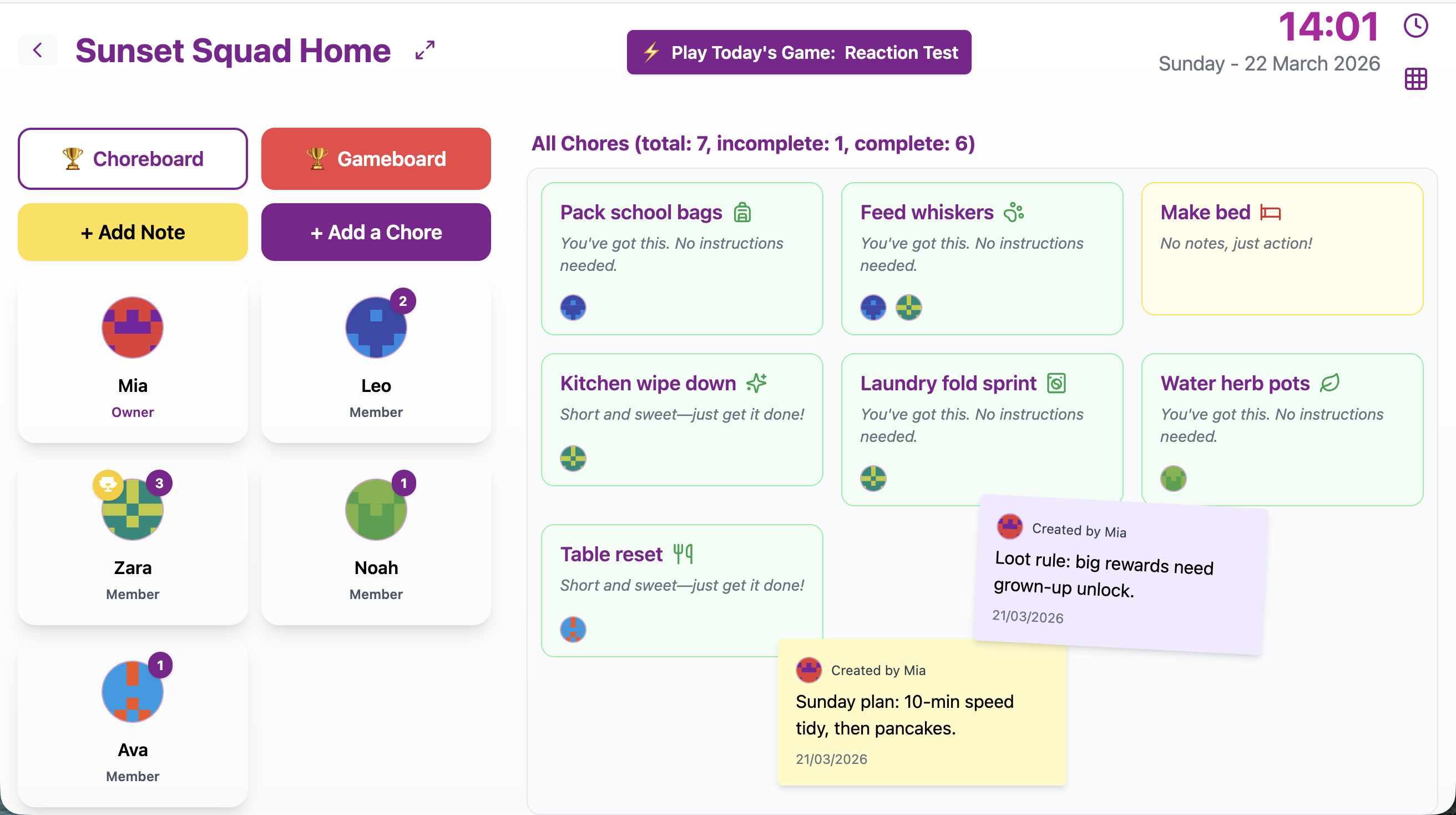
A visible list makes the restart easier because everyone can see the next small job.
You can use:
- A fresh sticky note.
- A small fridge chart.
- A kitchen whiteboard.
- A tablet in a shared space.
- A shared chore board.
Keep the first version short:
- Dishes after breakfast.
- Shoes by door.
- Clothes in basket.
That is enough to restart.
Visibility reduces the amount of reminding one person has to do. It also makes the reset feel like a shared system, not a stream of instructions from the nearest adult.
For more ideas, see making chores visible without nagging.
Restart with anchors
Habits are easier to rebuild when they attach to something that already happens.
When you are rebuilding the routine, do not rely on everyone simply remembering to help. Attach each reset job to a daily moment.
| Daily moment | Restart chore |
|---|---|
| After breakfast | Bowl or plate to sink |
| After getting dressed | Pyjamas or clothes to basket |
| Before screens | One quick job from the board |
| After dinner | Table cleared |
| Before bed | Bag or shoes ready |
Anchors make the routine less dependent on mood. They answer the question, “When do we do this?”
Short phrases help:
- “Breakfast is finished, plate by the sink.”
- “Screens after one quick job.”
- “After dinner, let’s clear the table.”
- “Before bed, clothes in the basket.”
- “Shoes by the door before story time.”
The phrase can be simple. In fact, simple is better. A restart routine should be easy to repeat, especially on tired days.
Let everyone choose one job
Choice helps restart a routine without making it feel forced.
The boundary can stay clear: everyone helps. The choice is about how.
Try asking:
- “Which of these three jobs do you want to own this week?”
- “Would you rather do shoes or table?”
- “Do you want a morning job or an evening job?”
- “Which job feels easiest to remember?”
This gives children a little ownership. It also helps you notice which jobs are realistic. If everyone avoids one task, it may be too vague, too big, or happening at the wrong time.
If fairness is a concern, rotate the jobs after a week. The first week is about restarting the rhythm, not solving every chore fairness question forever.
For more on fairness, see how to make chores feel fair.
Use a one-week reset plan
One week is a helpful restart window.
It is long enough to see patterns, but short enough that the restart still feels manageable.
Try this:
| Day | Focus |
|---|---|
| Day 1 | Pick three reset jobs and make them visible |
| Day 2 | Attach each job to a daily moment |
| Day 3 | Let everyone choose or swap a job |
| Day 4 | Shrink any job that is being avoided |
| Day 5 | Notice one thing that is working |
| Day 6 | Add one optional extra job if the routine feels steady |
| Day 7 | Review and choose next week’s simple list |
This keeps the reset gentle. You are not trying to rebuild the whole household in one afternoon. You are helping the family remember the rhythm, one small action at a time.
Mark progress quickly
When a family is restarting, visible progress matters.
It shows that the routine is coming back. It helps children see that small jobs count. It gives adults something better to say than “why is nobody helping?”
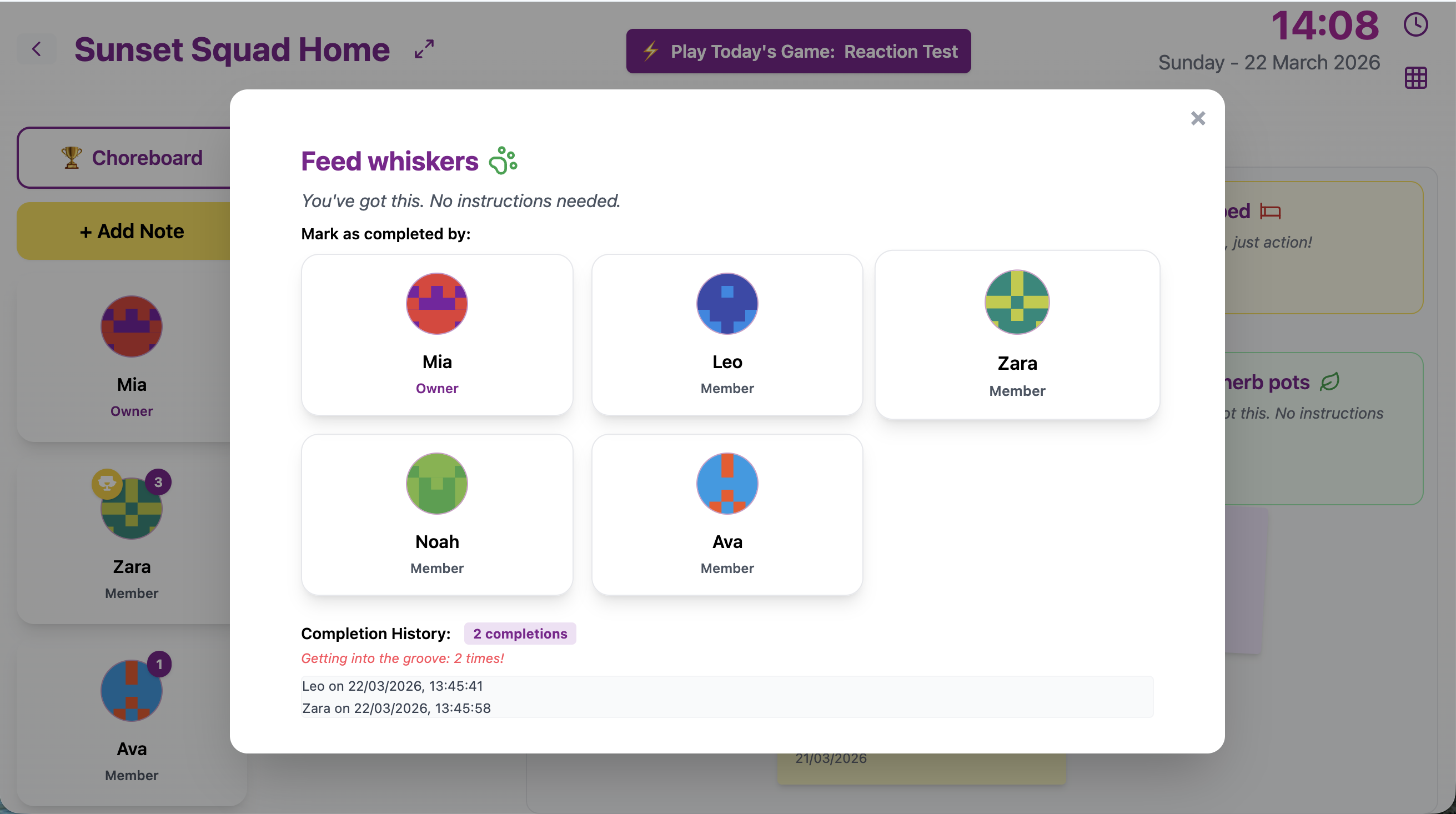
A quick completion step helps small reset jobs feel finished.
Progress can be marked with:
- Tick it off on a paper chart.
- Move a magnet from “to do” to “done”.
- Add a sticker for younger children.
- Tap the chore complete on a shared board.
- Move the task into a simple “done” column.
The completion step should be fast. If tracking the chore takes longer than doing the chore, the system is asking for trouble.
Chorish can help here because it gives households a visible board and quick completion action, but the same idea works with paper. The key is that everyone can see progress returning.
Expect the first week to be imperfect
The first week back will not be smooth.
Someone will forget. Someone will only move one shoe. Someone will complete a chore and forget to mark it. Someone will be tired. Someone will leave a sock exactly where it was.
That is normal.
Do not treat early wobbliness as failure. Treat it as information.
Ask:
- Was the chore too big?
- Was the timing wrong?
- Was the list visible enough?
- Did everyone know what “done” looked like?
- Were we trying to restart too many jobs?
Adjust from there.
Good routines survive because they can bend. If a reset job keeps failing, shrink it. Move it. Pair it with a better anchor. Give it to someone else. Try again.
Rebuild mornings and evenings separately
When family life has knocked chores off track, it can help to split the restart into morning and evening routines.
Mornings usually need speed and clarity:
- Plates away.
- Bags ready.
- Shoes found.
- Lunchboxes packed.
- One small personal reset.
Evenings usually need closure and preparation:
- Table cleared.
- Cups to kitchen.
- Clothes in basket.
- Bags by door.
- Shared space reset.
Do not try to fix both at full strength at once. Pick the one causing the most stress.
If mornings are the problem, start with our morning routines guide. If evenings are where everything unravels, the evening reset routine article has a simple 10 to 15 minute structure.
Have a tiny version for hard days
Messy weeks often settle down gradually. You may still have hard days while you are restarting.
That is why your reset needs a tiny version.
Try:
- Everyone does one helpful thing.
- One room gets a five-minute reset.
- Dishes to sink and shoes by door.
- Clothes in baskets, then stop.
- Pick the smallest job on the board.
This keeps the habit alive without pretending every day has the same energy.
Tiny versions are not cheating. They are how routines survive real life.
Review without a lecture
At the end of the week, do a short check-in.
Ask:
- What got easier?
- What still felt annoying?
- Which job should stay?
- Which job should shrink?
- What should we add next?
Keep the tone practical. You are not reviewing everyone’s character. You are adjusting a household system.
Our weekly family reset guide has a fuller structure for this kind of calm check-in.
Start again, gently
Chore routines do not need to be perfect to be useful.
They can pause. They can wobble. They can disappear when life gets messy and come back with a smaller list, a kinder tone, and a better anchor.
The restart does not have to be dramatic. Make the list visible. Choose three small jobs. Attach them to daily moments. Mark progress. Review after a week.
That is enough to begin.
If a shared digital board would help your family see the reset clearly, Chorish is free, browser-based, and does not require a sign-up. A fridge chart or whiteboard can work too. The best restart system is the one your household can see, repeat, and forgive when life gets messy again.