
A weekly family reset sounds suspiciously like the kind of thing that might involve a clipboard.
It does not have to.
At its best, a weekly reset is just a short, calm check-in where everyone looks at what needs doing, notices what worked, and makes the next week a little easier. No long speech. No dramatic recap of every abandoned sock. No “while we are all here, let us discuss your attitude toward the dishwasher” energy.
The point is not to run your home like a board meeting. The point is to stop the same chore arguments from showing up again and again every week.
A good weekly reset helps families answer a few simple questions:
- What got done?
- What kept getting missed?
- What needs changing?
- Who can help with what this week?
- How do we keep the tone kind?
Here is a practical way to run a weekly family reset that feels useful, not lecture-y.
Pick a reset moment that already fits your week
The best reset time is not necessarily Sunday evening. Sunday evening works for some families, but for others it is a blur of school bags, half-finished homework, and someone suddenly remembering they need cardboard for tomorrow.
Pick a day and time that fits your real household.
Good reset moments might be:
| Reset time | Why it can work |
|---|---|
| Friday after dinner | Wraps up the school week before everyone switches off |
| Saturday morning | Helps plan weekend jobs before the day runs away |
| Sunday afternoon | Gives space before the new week starts |
| Monday after school | Works well if weekends are too busy |
| Any quiet weekday evening | Better than forcing a perfect schedule that never happens |
The reset should be short. Ten minutes is plenty for most families. If it starts taking much longer, it is probably trying to solve too many problems at once.
Try giving it a friendly name too. “Weekly reset” is fine. “Family chore review meeting” may make everyone suddenly need the toilet.
Start with what went well
If the reset begins with a list of failures, children will quickly learn to dread it. Adults probably will too.
Start with one or two wins.
They can be tiny:
- “The lunchboxes got emptied more often this week.”
- “The hallway stayed clearer.”
- “The dog was fed without me asking twice on Tuesday.”
- “Everyone did at least one kitchen job.”
- “The living room reset before screens worked twice.”
This is not pretending everything was perfect. It is showing that effort counts. A weekly reset should feel like the family looking at the system together, not one person standing at the front of the room preparing to prosecute the towel situation.
If your family uses a visible chore board, start there. Look at what was completed and what patterns show up. If you use paper, stickers, sticky notes, or a whiteboard, those work too. The key is to point at something shared instead of relying on memory.
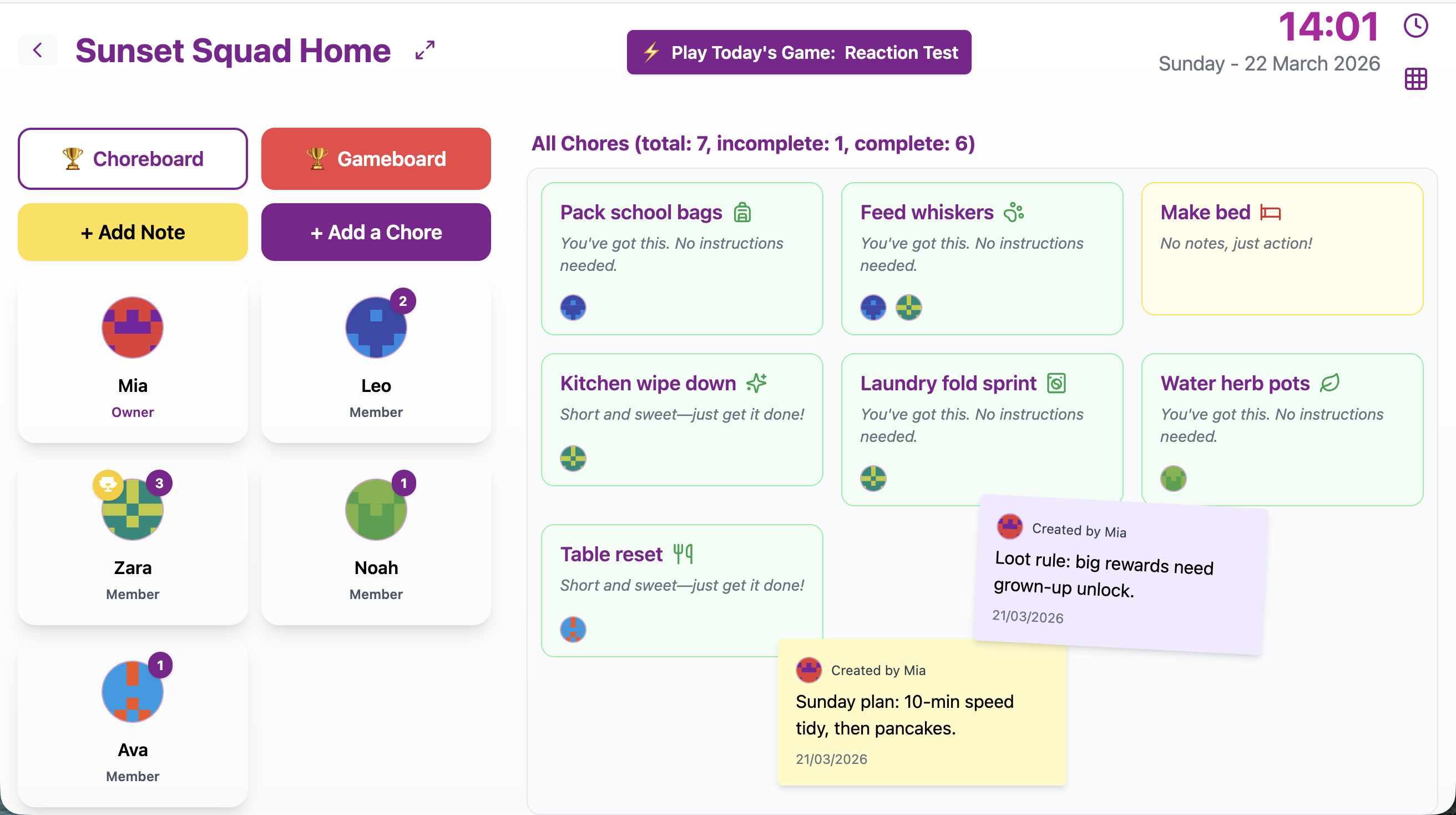
A visible list gives the family something neutral to look at together.
This helps lower the emotional temperature. Instead of “you never help”, the conversation becomes “the bathroom jobs were missed this week; what would make those easier?”
Keep the reset agenda simple
A weekly reset works best when everyone knows what is coming.
Try this five-part structure:
- Notice one win.
- Check what got missed.
- Choose any chore changes.
- Pick a few focus jobs for the week.
- End with something light.
That is it.
You do not need to solve every household issue. In fact, please do not. A reset that tries to fix school mornings, pocket money, screen time, sibling bickering, meal planning, and the mysterious smell near the shoe rack will become too heavy to repeat.
Keep the focus narrow: chores, household routines, and the next week.
Review what got missed without blaming
Every family has chores that keep slipping through the cracks.
Bins. Towels. Lunchboxes. The cup collection that appears beside the sofa as if a tiny cafe opened there overnight.
The weekly reset is a good time to ask why something is being missed. Not in a suspicious detective voice. In a practical, curious voice.
Try:
- “This one did not happen much. Is it too hard to remember?”
- “Does this chore need to move to another time of day?”
- “Is the job too big?”
- “Do we need to explain what ‘done’ looks like?”
- “Should this be split into smaller jobs?”
Often, a missed chore is not a character flaw. It is a design problem.
“Clean the bathroom” might be too vague for a child. “Put towels in the basket and wipe the sink” is clearer.
“Sort laundry” might be too large. “Bring your laundry basket down on Saturday morning” is a better first step.
“Tidy your room” can feel too big and vague to start. “Books on shelf, clothes in basket, cups to kitchen” gives the job edges.
If you are choosing jobs for different ages, our guide to age-appropriate chores for kids has practical examples that can make the reset easier.
Adjust the chore list like a living thing
One of the biggest mistakes families make is treating the chore list as if it was carved into stone by ancient household administrators.
Your week changes. Your chore list can change too.
During the reset, look for chores that need adjusting:
- A job is too big and needs splitting.
- A child has outgrown a task and can take on more.
- A younger child needs a simpler version.
- A chore keeps being forgotten because it happens at the wrong time.
- A seasonal job needs adding or removing.
- One person has had a busier week and needs a lighter load.
This is where a digital list can be handy, because it is easy to tweak without rewriting the whole chart. But a paper chart can work perfectly well if you keep it flexible. Sticky notes are wonderfully low-pressure here: move them, swap them, remove them, add a new one. Very satisfying. Almost too satisfying.
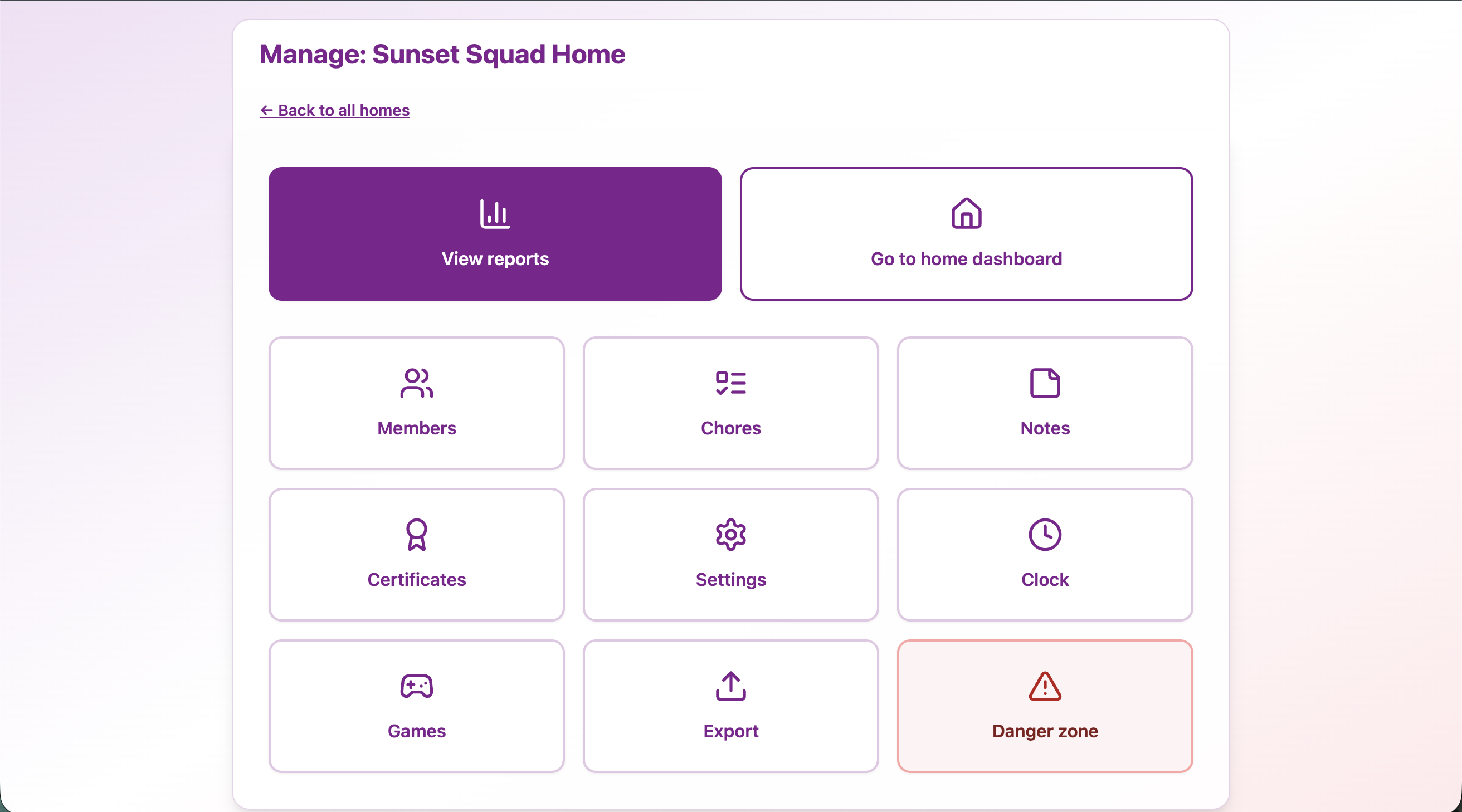
A reset is a good time to tweak the list, not start from scratch.
The goal is not perfect equality every week. It is a fair, visible system that can survive actual life.
Choose two or three focus jobs
A full chore list can be useful, but a weekly reset becomes easier when you pick a few focus jobs.
These are the chores that matter most this week.
For example:
- Keep school bags off the hallway floor.
- Empty lunchboxes after school.
- Clear plates after dinner.
- Reset the living room before bedtime.
- Bring laundry baskets down on Saturday.
Focus jobs help families avoid the feeling that everything matters equally all the time. It does not. Some weeks, the kitchen is the priority. Other weeks, the hallway needs rescuing. Sometimes the main goal is just “please, no wet towels on beds.”
Try asking:
- “What would make mornings easier this week?”
- “What mess kept annoying everyone?”
- “What is one job each person can own?”
- “What should we stop worrying about for now?”
That last question is underrated. A good reset is not only about adding jobs. It is also about letting go of things that do not matter this week.
Give children a real voice
A reset works better when children are not just receiving instructions.
Ask for their input:
- “Which chore feels easiest for you to remember?”
- “Which one feels annoying?”
- “Would you rather do table wiping or shoe sorting?”
- “What would help you remember this?”
- “Do you want a morning job or an after-school job?”
You do not have to accept every suggestion. “I suggest I do no chores and receive snacks” is bold, but perhaps not the final policy. Still, giving children a voice helps them feel part of the system.
Choice is especially helpful for chore routines because it turns “you must” into “which one will you take?” The boundary stays clear, but the child gets some control inside it.
If your household is just starting out, our guide on introducing chores without a family fight has more ideas for keeping the first conversations calm.
Use visible progress instead of memory
Memory is a terrible chore tracker.
Parents remember the jobs they had to ask about. Children remember the jobs they did while nobody was looking. Siblings remember, with impressive confidence, that they definitely did more than everyone else.
A visible record makes the reset easier.
That record might be a paper checklist, a fridge chart, a whiteboard, or a shared digital board like Chorish. It simply needs to show what was done and what still needs attention.
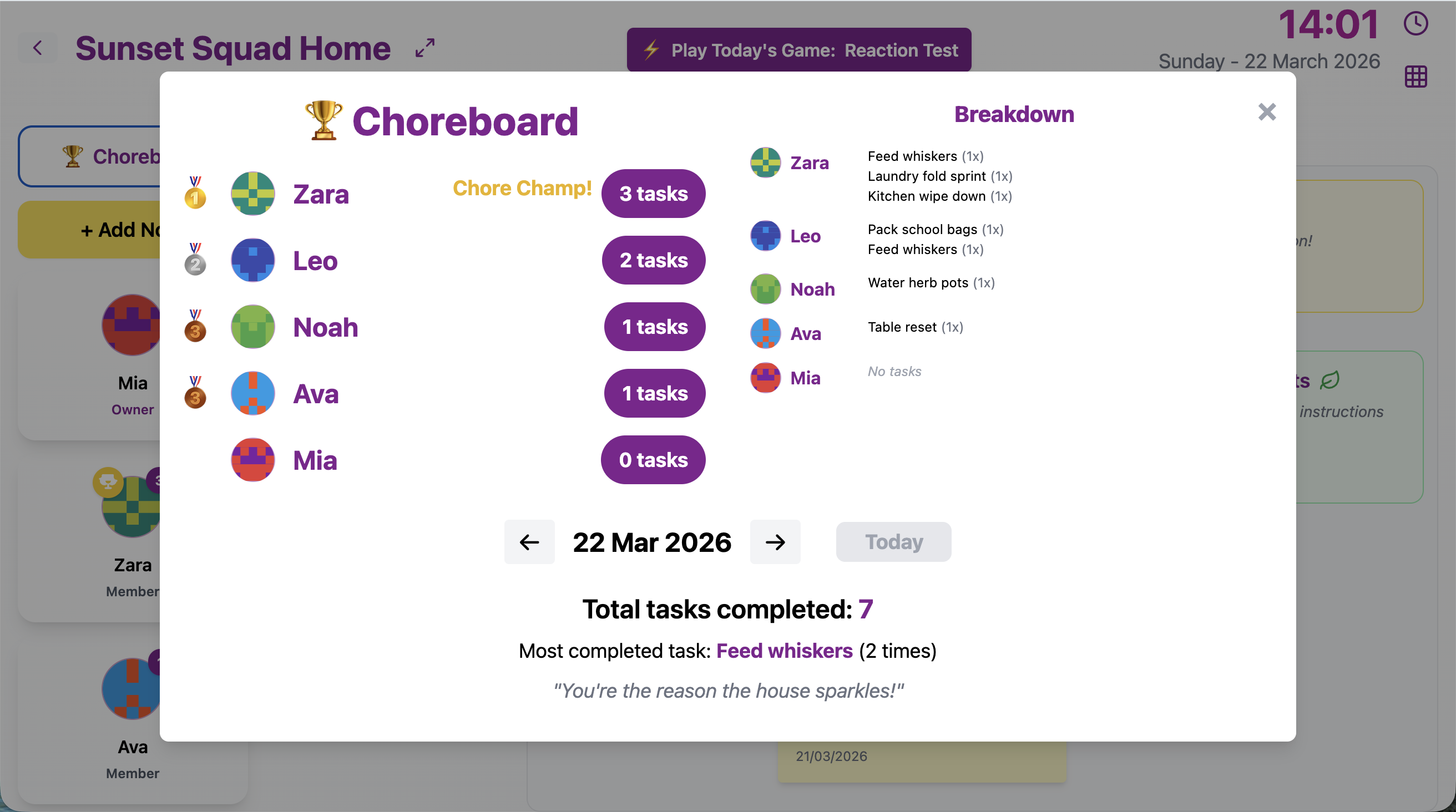
Visible progress can turn the reset into a quick review rather than a debate from memory.
The key is to use the board as a neutral reference, not a scoreboard of personal worth.
Helpful:
- “The board shows the kitchen jobs went well.”
- “Laundry was missed a lot. How can we make that easier?”
- “Everyone has some wins this week.”
Less helpful:
- “Look how far behind you are.”
- “Your sister did more, so explain yourself.”
- “This board proves my point.”
The tool should reduce arguing, not become a laminated judge.
End with something light
If the weekly reset always ends with more jobs, it may start to feel heavy.
End with something small and pleasant:
- Choose a quick family game.
- Pick a film for later.
- Make a snack.
- Let someone choose music for the kitchen reset.
- Do one tiny “reset sprint” together and then stop.
If you use Chorish, a quick game after reviewing chores can be a nice way to close the loop. It keeps the mood playful and reminds everyone that the chore system is there to help the household, not drain all joy from the room.
Our article on why a quick game after a chore is a break, not a distraction explains that idea in more detail.
The important part is the tone: “We checked in, we made a plan, now we can move on.”
A sample 10-minute weekly reset
Here is a simple script you can adapt.
Minute 1: Start warm
“Let us do a quick reset for the week. First, one thing that worked: the table got cleared most nights. Thank you.”
Minutes 2-3: Look at the board
“What got done? What kept getting missed?”
Minutes 4-5: Fix one problem
“Lunchboxes were missed. Should we make that an after-school job and put it at the top of the list?”
Minutes 6-7: Choose focus jobs
“This week, let us focus on lunchboxes, shoes by the door, and plates after dinner.”
Minute 8: Let children choose
“Which job do you want to own first?”
Minute 9: Make it visible
“We will add it to the board now.”
Minute 10: End lightly
“Done. Quick game or snack?”
That is enough. A short reset that actually happens is better than a perfect reset that everyone avoids.
What if the reset turns into a lecture?
It happens.
You start with good intentions, then suddenly you are eight minutes into a speech about shoes, respect, effort, and the general decline of hallway standards.
If you notice the reset becoming a lecture, pause and shrink the conversation.
Try:
- “Let us pick one thing to fix.”
- “We do not need to solve everything today.”
- “What would make this easier next week?”
- “Let us make the job smaller.”
- “We are here to adjust the system, not blame people.”
That last sentence is useful for adults too. The reset is not a trial. It is maintenance.
Keep it flexible
Some weeks, the reset will be five minutes. Some weeks, it may not happen at all. That is fine.
The point is to create a rhythm you can return to. A missed reset does not mean the system has failed. It means life happened. Try again next week, or pick a smaller version:
- Notice one win.
- Pick one focus job.
- Move one sticky note.
- Update one chore.
That still counts.
Small resets are powerful because they stop chore routines from going stale. They give families a way to adjust before irritation builds up. They help children see that household jobs are not random commands. They are shared work, and shared work can be talked about calmly.
Keep the next week clearer
A weekly family reset is not about becoming a perfect household.
It is about making the next week slightly less foggy.
When chores are visible, expectations are clear, and the family has a small moment to adjust, there is less need for nagging in the middle of busy days. Everyone can see the plan. Everyone can see progress. Everyone gets a chance to say what is working and what is not.
If you want a simple place to keep that shared list, Chorish is free, browser-based, and does not require a sign-up. A paper chart or kitchen whiteboard can work too. The best system is the one your household will actually look at, use, and forgive when real life gets messy.