
Mornings can be a lot.
Someone cannot find a shoe. Someone has remembered a form. Someone is standing next to their lunchbox as if the lunchbox might pack itself if given enough emotional support.
Meanwhile, the clock is doing its usual morning trick of moving at twice the normal speed.
A good family morning routine is not about creating a perfect household before 8am. That is a lot to ask from people who may still be negotiating with their socks. The goal is simpler: make the next step obvious, keep chores small, and reduce the number of things one parent has to remember out loud.
Morning chores work best when they are quick, visible, and attached to things your family already does. Breakfast happens. Getting dressed happens. Bags need to leave the house. Those existing moments can become useful anchors for tiny household jobs.
Here is how to build a morning routine that actually works for busy families, without turning the kitchen into a command centre with a stress soundtrack.
Start with the real morning, not the dream morning
Before making a routine, look honestly at what your mornings are like.
Some families have a slow breakfast. Some have ten minutes, one available spoon, and a child who suddenly needs to bring a pine cone to school. Some mornings include toddlers, teenagers, pets, work calls, school runs, or all of the above.
The routine needs to fit the morning you actually have.
Ask:
- What usually causes the most stress?
- What gets forgotten most often?
- Which jobs would make the biggest difference if they happened daily?
- Which chores are too much for a school morning?
- What can be prepared the night before?
This matters because a morning routine should not be a giant list. If the list is too long, everyone learns to ignore it. Pick the few jobs that make the morning smoother and leave the deep cleaning for another time.
For many families, that means focusing on:
- Breakfast dishes.
- Lunchboxes.
- Bags.
- Shoes and coats.
- Beds or bedroom floors.
- Pet feeding.
- Quick kitchen or table reset.
Small, repeatable jobs are the morning routine sweet spot.
Use anchors, not constant reminders
An anchor is something that already happens. You attach a small chore to it so the routine is easier to remember.
For example:
| Existing morning moment | Small chore to attach |
|---|---|
| After breakfast | Put plate by the sink or into dishwasher |
| After getting dressed | Put pyjamas away or in laundry basket |
| Before shoes | Check bag is packed |
| Before leaving the kitchen | Put lunchbox in bag |
| Before screens or play | Pick one quick job from the list |
| Before walking out | Coat, shoes, bag, water bottle check |
This is much easier than saying “please help more in the morning”, which is true but not especially useful at 7:42am.
Try using short phrases:
- “Breakfast done, plate away.”
- “Dressed means pyjamas away.”
- “Bag check before shoes.”
- “One quick job before we go.”
- “Lunchbox in bag, then coat.”
The phrase should be clear enough that everyone knows what happens next. It may feel repetitive at first, but that is the point. A routine becomes easier when the words stay the same.
Our article on one small chore before screens uses the same idea: attach a tiny helpful action to a moment that already happens.
Make the list visible
Morning reminders are tiring because they often live in one person’s head.
The parent remembers the water bottle, the school shoes, the reading book, the empty cereal bowl, the wet towel, the PE kit, and the fact that the bins go out today. Everyone else simply experiences a mysterious stream of instructions from the direction of the kettle.
A visible checklist helps move some of that memory out of your head and into the room.
The list can be:
- A fridge checklist.
- A kitchen whiteboard.
- A printed routine card.
- Sticky notes by the door.
- A tablet on the kitchen counter.
- A shared digital chore board.
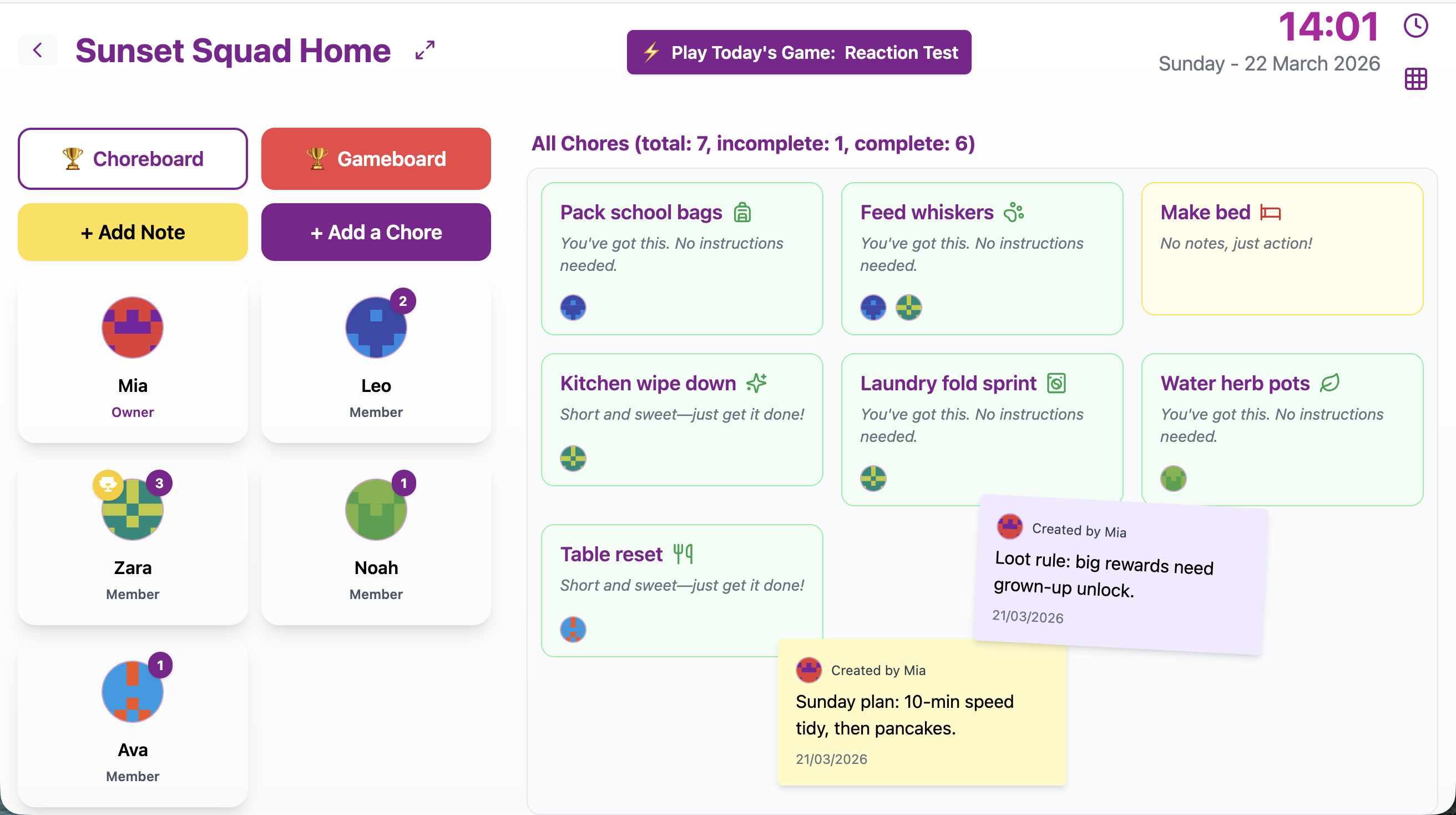
A visible morning list makes it easier for everyone to see the next job.
Keep the list short. A useful morning list might only have five items:
- Plate away.
- Lunchbox in bag.
- Pyjamas away.
- Shoes by door.
- Water bottle check.
If your child can read, words may be enough. For younger children, use pictures, icons, colours, or very simple labels. The goal is not to make the list impressive. The goal is to make it usable while people are still waking up.
For more on this, the guide to making chores visible without nagging has practical ways to make the list do more of the reminding.
Match morning chores to age and energy
Morning chores should match the child, the available time, and the mood of the house.
This does not mean children only get easy jobs forever. It means the morning is not always the best time to introduce a large new responsibility. Start with tasks that are clear and repeatable, then build from there.
| Age range | Morning chore ideas |
|---|---|
| Preschool | Put pyjamas in basket, place spoon by sink, choose shoes with help |
| Ages 5-7 | Put plate away, pack water bottle, put reading folder in bag |
| Ages 8-10 | Empty breakfast spot, check bag list, feed pet, help younger sibling with shoes |
| Tweens | Make simple breakfast, pack lunchbox, reset counter, take bins out if suitable |
| Teens | Own full bag check, manage laundry item, help with pet care, reset shared space |
The key is to define what “done” looks like.
“Get ready” is vague. “Dressed, pyjamas in basket, bag by door” is clearer.
“Help in the kitchen” is vague. “Put your bowl in the dishwasher and wipe your spot” is easier to act on.
If you want more chore ideas by stage, see our age-appropriate chores for kids guide.
Build a three-part morning routine
A morning routine is easier to follow when it has a shape.
Try dividing it into three parts:
1. Wake and dress
Keep this part simple. The aim is to get people dressed and reduce bedroom mess before it becomes an afternoon problem.
Possible chores:
- Pyjamas in basket.
- Bed pulled up enough to look intentional.
- Clothes not worn returned to drawer or hook.
- Book or toy back in place.
For younger children, one bedroom job is enough. For older children, a small room reset can become part of getting dressed.
2. Breakfast and kitchen reset
Breakfast is a natural anchor because it creates dishes and crumbs. It is also a good place to build the idea that eating includes a small reset afterwards.
Possible chores:
- Plate or bowl by sink.
- Spoon in dishwasher.
- Cup moved to kitchen.
- Cereal box away.
- Table spot wiped.
- Chair pushed in.
This does not need to become a full kitchen clean. A morning reset is about leaving the kitchen usable, not showroom-ready.
3. Door check
The door check is the final pass before everyone leaves.
Possible chores:
- Bag packed.
- Lunchbox in bag.
- Water bottle filled.
- Shoes on or by the door.
- Coat ready.
- Reading folder or homework checked.
This is where a visible list near the exit can be especially useful. The list catches the obvious things before the front door opens and everyone remembers the obvious things in the car.
Plan for chaotic mornings
Some mornings will not go to plan.
Someone sleeps badly. The alarm does not happen. The cereal runs out. A child suddenly announces that today is “wear something green day”, which is important information and also perhaps could have been shared yesterday.
A good morning routine needs a smaller version for days like this.
Try having a “minimum morning” list:
- Dressed.
- Teeth.
- Bag.
- Lunch.
- One tiny reset.
That tiny reset might be putting breakfast dishes by the sink or moving pyjamas to the basket. It keeps the habit alive without pretending every morning has the same amount of space.
This is similar to the idea in why a two-minute chore still counts: small jobs still matter because they keep momentum going.
Prepare some jobs the night before
The easiest morning chore is sometimes the one you remove from the morning.
If mornings feel too packed, move a few decisions to the evening:
- Put bags by the door.
- Choose clothes.
- Fill water bottles.
- Check lunchboxes.
- Put shoes in the same place.
- Add tomorrow’s top chores to the visible list.
You do not need a perfect evening routine. Even one prepared item can help. The aim is to reduce the number of tiny decisions that pile up before school or work.
If your household already does a weekly check-in, use it to ask, “What keeps making mornings harder?” Our weekly family reset guide has a simple structure for that kind of conversation.
Mark morning chores done quickly
Children often like knowing that the job counted.
That can be as simple as ticking a paper chart, moving a magnet, or tapping a chore complete on a shared board. The important thing is that the completion step is quick. Nobody needs a ten-step admin process before breakfast.
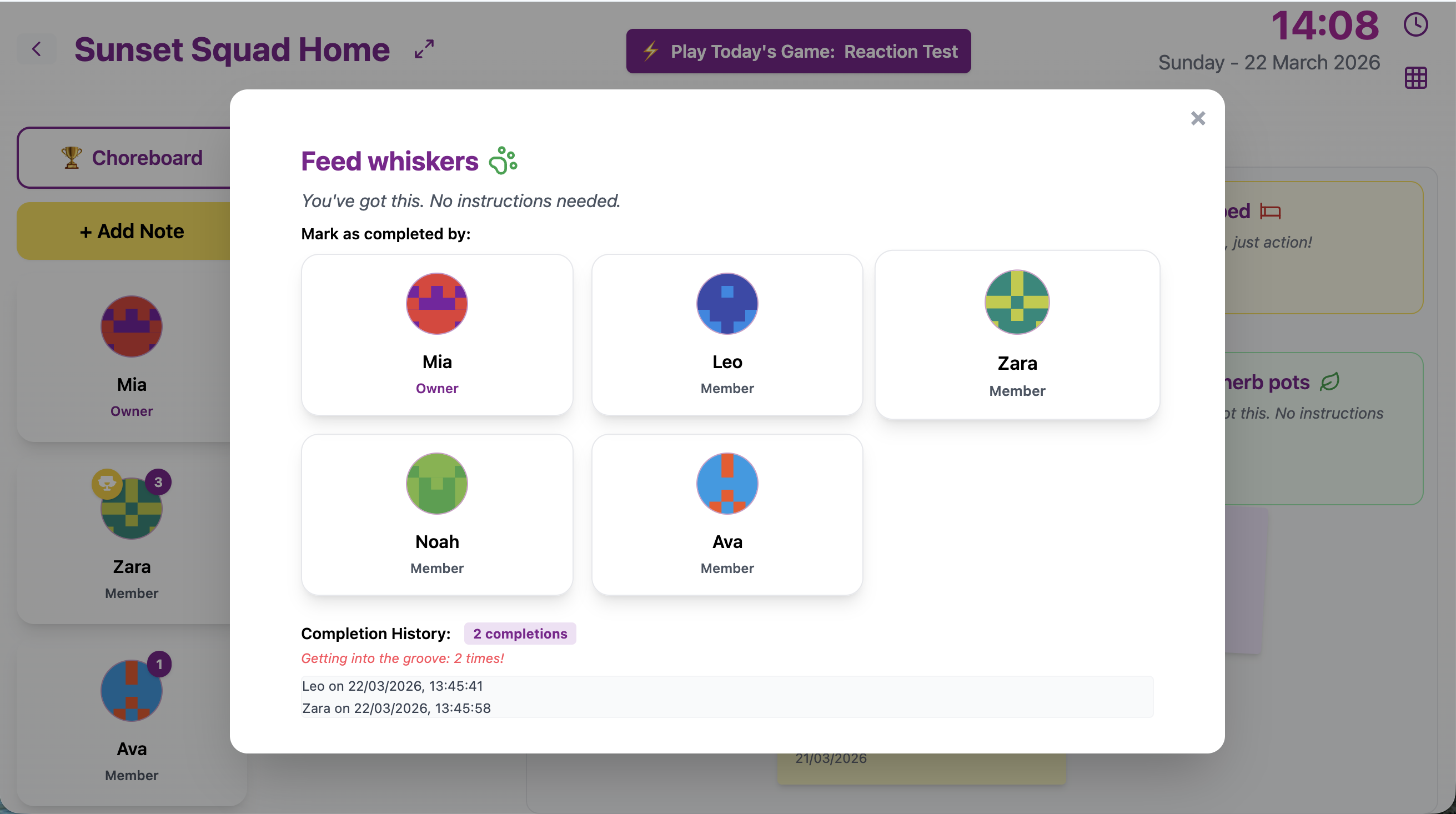
A quick completion step helps children see that small morning jobs count.
This creates a helpful loop:
- See the task.
- Do the task.
- Mark it done.
- Move to the next part of the morning.
The loop is simple enough to repeat. It also gives parents a calmer prompt: “Mark it done, then shoes.”
Keep praise specific and brief
Morning praise should be quick. Everyone has places to be.
Specific praise works better than a general “good job” because it connects the action to the result.
Try:
- “Thanks, your bowl is away.”
- “That made the table easier to clear.”
- “Good bag check.”
- “You remembered the water bottle without a reminder.”
- “Nice quick reset.”
Avoid turning praise into a hidden complaint:
- “See, why can’t you do that every day?”
- “Finally.”
- “That was not so hard, was it?”
Those lines are tempting on tired mornings, but they can make the routine feel heavier. Keep the tone simple: notice the helpful action, then move on.
Use a shared board for hand-off
In many homes, morning tasks are split between adults. One person starts breakfast. Another handles shoes. Someone else needs to know whether the dog was fed, the lunchbox was packed, or the reading folder made it into the bag.
A shared visible board can make that hand-off easier.
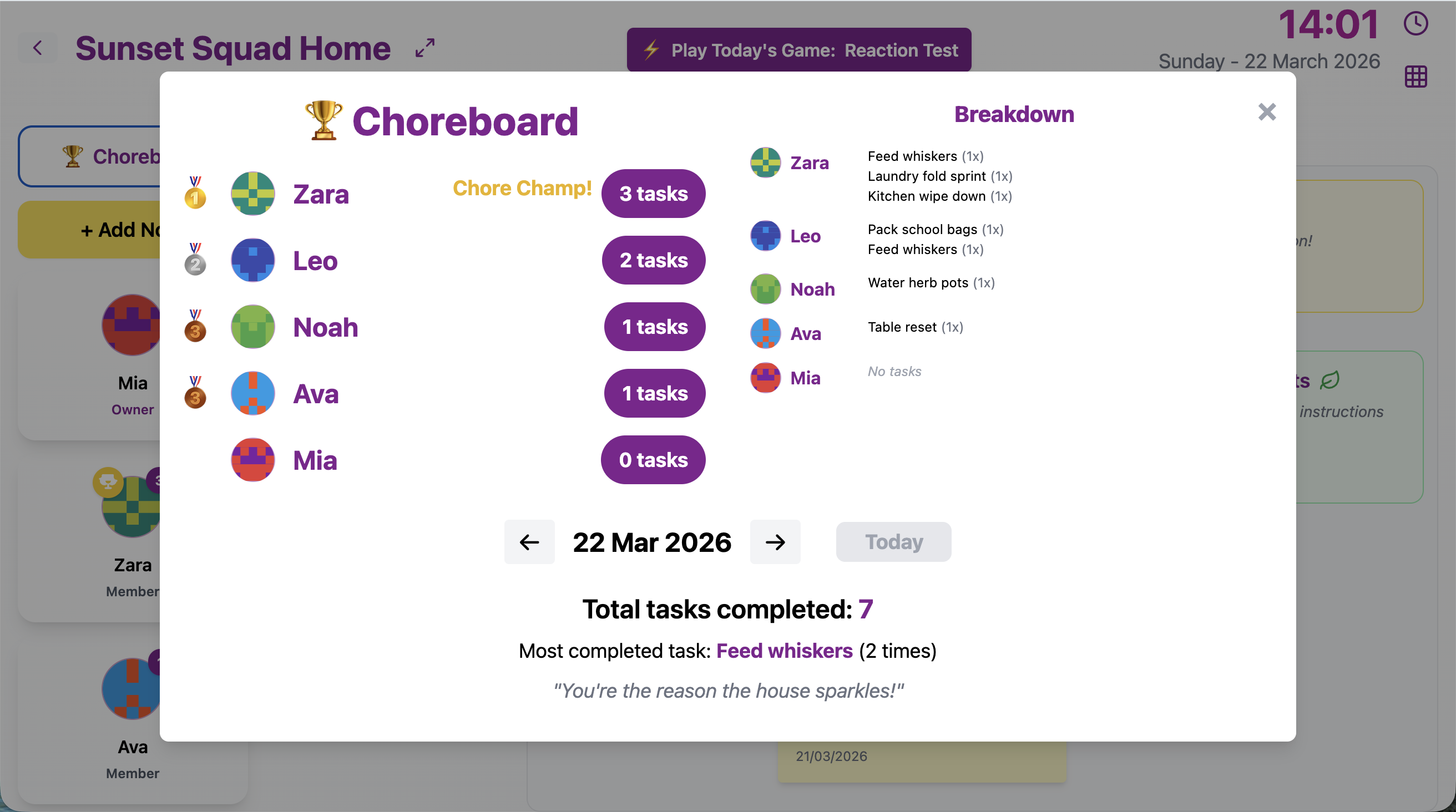
A shared board can make it easier to see what has already happened in a busy morning.
This is where a browser-based tool like Chorish can help, especially if you keep a tablet in a shared space. It is not the only option. A whiteboard can work too. The important part is that the list is visible to more than one person.
When everyone can see what is done, the morning depends less on one person’s memory.
A simple first-week plan
If your mornings feel messy, do not overhaul everything at once.
Try this one-week plan:
- Pick one morning stress point.
- Choose three tiny chores that would help.
- Put them somewhere visible.
- Attach each chore to an existing moment.
- Use the same short phrase every day.
- Mark jobs done quickly.
- Review what worked at the end of the week.
For example:
| Stress point | Tiny routine |
|---|---|
| Shoes missing | Shoes by door after getting dressed |
| Breakfast mess | Plate away before bag check |
| Forgotten lunchbox | Lunchbox in bag before shoes |
| Bedroom mess | Pyjamas in basket before breakfast |
| Parent reminders | Visible checklist near kitchen table |
After a week, keep what worked and shrink what did not. A routine that needs adjusting is not a failure. It is just a routine meeting real life.
Make mornings calmer, not perfect
The goal of a family morning routine is not to create a perfect start every day.
The goal is to make mornings easier to repeat.
Small chores help because they turn vague expectations into clear actions. A visible list helps because it reduces the number of reminders one person has to carry. Age-appropriate jobs help because children can start contributing in ways that actually fit the morning.
Some days will still be messy. That is normal. The right routine gives you something to come back to the next day.
If you want a simple shared list for morning chores, Chorish is free, browser-based, and does not require a sign-up. A fridge chart or whiteboard can work well too. Pick the system your family will actually see before the shoes disappear.