
“I did more!”
It is one of the classic household chore complaints, usually delivered with the confidence of someone who has been keeping detailed mental records since breakfast.
Sometimes they are right. Sometimes they are not. Sometimes one child emptied the dishwasher once and now considers themselves the backbone of the entire household.
Chore fairness is tricky because family life is rarely perfectly equal. Children have different ages, schedules, energy levels, strengths, moods, and tolerance for sock-related responsibility. Adults have busy weeks. Routines change. Someone is ill. Someone has homework. Someone has decided that wiping the table is “not really their area”.
The goal is not perfect equality every day. The goal is a system that feels understandable, visible, and fair enough to keep everyone moving.
Here is how to make chores feel fair without turning your home into a courtroom with laundry baskets.
Fair does not always mean equal
The first step is separating fairness from exact equality.
Equal means everyone does the same amount.
Fair means the work makes sense for each person.
Those are not always the same thing.
A six-year-old and a twelve-year-old probably should not have identical chore lists. A child with three clubs this week may need a lighter day. A teenager can usually handle a more independent job than a younger sibling. A parent working late may not be able to do the usual evening reset. Real life keeps moving, whether the chart is ready or not.
Fair chores often take into account:
- Age and ability.
- School, work, and activity schedules.
- How long a task takes.
- How difficult or unpleasant a task feels.
- Whether the task needs adult help.
- Whether someone has had an unusually hard week.
This does not mean every complaint gets a full policy review. It simply means the family can talk about fairness in a more useful way than “everyone gets exactly the same job forever”.
If you are matching jobs to different ages, our age-appropriate chores guide has practical ideas for building lists that fit the child, not just the room.
Make the work visible
Fairness is much harder when chores are invisible.
One person remembers putting the bins out. Another remembers clearing the table. Someone else remembers being asked to do “everything”, which may have included one sock and a powerful feeling.
When the chore list lives in one parent’s head, arguments are almost guaranteed. Nobody can see the whole picture. Everyone is working from memory, and memory is a very unreliable household manager.
A visible list changes the conversation.
That list might be:
- A paper chart on the fridge.
- A whiteboard in the kitchen.
- Sticky notes on a cupboard.
- A tablet in a shared space.
- A digital chore board everyone can check.
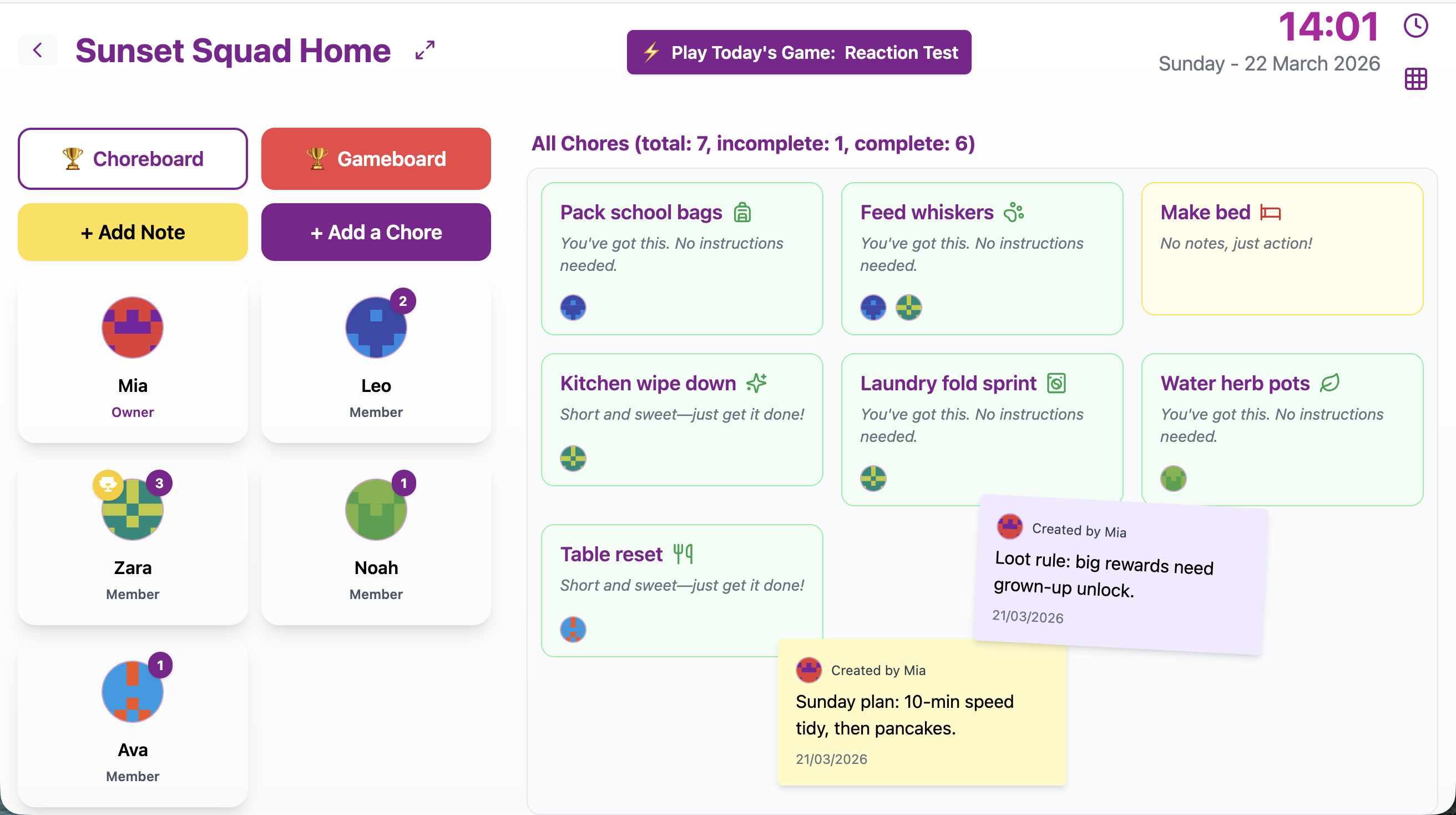
A visible list helps everyone see what needs doing, not just what one person remembered to mention.
Once the work is visible, the question becomes less emotional:
- “Which jobs are left?”
- “Who has already done something today?”
- “Which tasks are too big?”
- “Which chores need moving?”
- “Is the list balanced enough for this week?”
That is much calmer than “you never help”, even when the hallway strongly suggests otherwise.
Our guide to making chores visible without nagging goes deeper on this idea: the clearer the list is, the less one person has to become the household reminder system.
Define what each chore actually means
Chores feel unfair when one person thinks a task is tiny and another person knows it is secretly three tasks wearing a coat.
“Clean the kitchen” might mean:
- Clear plates.
- Load dishwasher.
- Wipe surfaces.
- Put food away.
- Sweep crumbs.
- Take bins out.
That is not one chore. That is a small domestic expedition.
To make chores feel fair, define the job clearly. A good chore has a visible finish line.
| Vague chore | Clearer version |
|---|---|
| Tidy your room | Clothes in basket, books on shelf, cups to kitchen |
| Help with dinner | Set plates and forks before food is served |
| Clean the bathroom | Put towels in basket and wipe the sink |
| Do the kitchen | Put plates in dishwasher and wipe table |
| Sort laundry | Bring your basket downstairs on Saturday |
Clear chores reduce arguments because everyone knows what “done” looks like.
They also help children start. “Tidy your room” can feel too big. “Put clothes in the basket” is easier to understand, easier to finish, and easier to mark complete.
Balance easy jobs and hard jobs
Not all chores are equal.
Some are quick and painless. Some are sticky, smelly, heavy, boring, or likely to involve discovering something alarming under a bed.
If one child always gets the easy jobs and another always gets the harder ones, the list may look balanced on paper but feel unfair in real life.
Try grouping chores by effort:
| Light jobs | Medium jobs | Bigger jobs |
|---|---|---|
| Put shoes away | Empty lunchbox | Vacuum one room |
| Feed pet with help | Wipe table | Clean bathroom sink |
| Put books back | Load dishwasher | Take bins out |
| Water one plant | Fold towels | Change bedding |
Then aim for a mix. A child might have two light jobs and one medium job. An older child might have one bigger job and a few smaller ones. A busy school night might only need light jobs.
The goal is not to create a perfect points system for every crumb. It is to avoid a pattern where one person quietly gets the tough end of the list every time.
Use age-appropriate responsibility
Fairness changes as children grow.
A younger child may need visible, simple tasks:
- Put spoons by the sink.
- Match socks.
- Put toys in one basket.
- Carry napkins to the table.
An older child can handle jobs with more steps:
- Pack lunchbox.
- Empty dishwasher section.
- Sweep under the table.
- Take laundry to the right room.
Tweens and teens can often own recurring responsibilities:
- Manage their school bag.
- Reset a shared space.
- Take bins out.
- Do a laundry step.
- Help with pet care.
The key is to explain why jobs differ.
Try saying:
- “Fair does not mean everyone has the same task. It means everyone has a helpful task that fits them.”
- “You are older, so this job is yours now. Your younger sibling has a smaller job.”
- “This week is busy, so we are keeping the list lighter.”
- “We are all helping, but not always in identical ways.”
Children may still protest. That is allowed. But the explanation gives the system a logic beyond “because I said so while holding a damp towel”.
Keep a shared record
Many chore arguments are really memory arguments.
“I did that yesterday.”
“No, I did.”
“You always get easier jobs.”
“I already helped loads.”
Nobody has to be lying for this to become messy. People naturally remember their own effort more clearly than other people’s. A shared record helps.
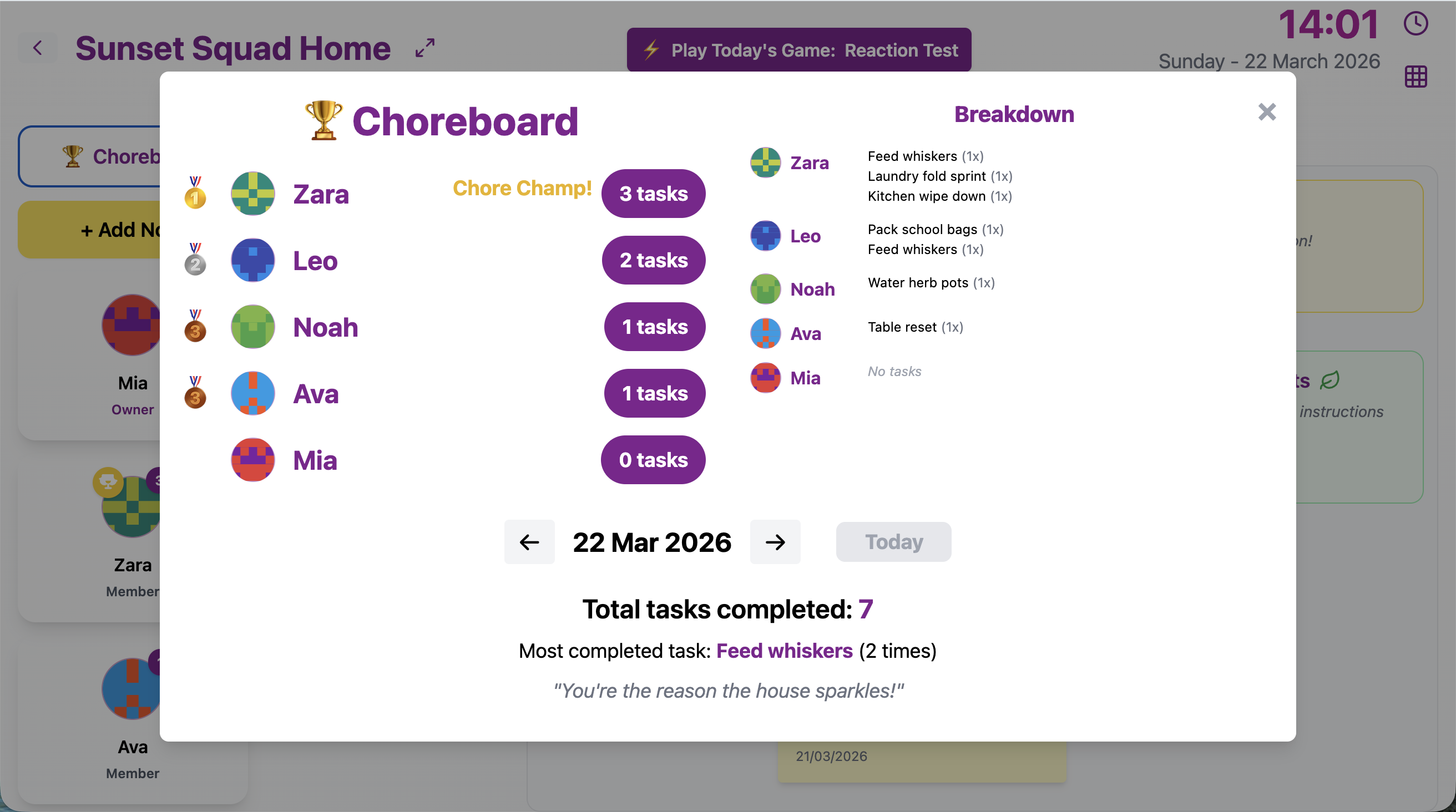
A shared record can reduce “who did what” arguments because everyone is looking at the same view.
A record can be simple:
- Ticks on a paper chart.
- Magnets moved from “to do” to “done”.
- A weekly checklist.
- A shared board on a tablet.
The record should answer basic questions:
- What was done?
- Who did it?
- What is still left?
- What keeps getting missed?
This is where Chorish can be useful, because a shared Choreboard gives the household one visible place to see progress. But the principle works with paper too. The important part is that the record is shared, not hidden in one person’s memory.
For a deeper comparison, see Chore Charts vs. a Live Scoreboard: What Actually Gets Kids to Pitch In.
Be careful with competition
Friendly competition can motivate some families.
A scoreboard, medal, or weekly tally can make chores feel more visible and playful. It can also help older children see their effort building up over time.
But competition needs a soft edge.
If one child is delighted by the leaderboard and another feels defeated before they start, the system needs adjusting. The point is teamwork, not turning the dishwasher into a championship sport.
Use competition when it helps:
- Celebrate effort.
- Notice progress.
- Add energy to repetitive tasks.
- Make small wins visible.
Step back when it causes:
- Stress.
- Sibling arguments.
- Boasting.
- Giving up.
- One child feeling permanently behind.
Helpful framing:
- “The board shows progress, not personal worth.”
- “Everyone can add helpful wins.”
- “We are trying to beat the mess, not each other.”
- “If the scoreboard stops helping, we can use it differently.”
Fairness is not only about who did most. It is also about whether the system keeps everyone willing to help.
Build in flexibility for real life
Rigid chore systems often look fair at first.
Then real life arrives.
Someone has a school trip. Someone is ill. Homework explodes. A parent is working late. A younger child has a wobble over socks. The dog needs attention. The dishwasher chooses drama.
A fair chore system needs room to bend.
Try using phrases like:
- “This is the usual plan, but today is unusual.”
- “You have a busy evening, so choose one smaller job.”
- “We will swap this chore for tomorrow.”
- “You helped extra yesterday, so today can be lighter.”
- “The list still matters, but we can adjust it.”
Flexibility is not the same as giving up. It is how the routine survives.
The weekly reset is a good place to make these changes calmly. If one chore keeps causing trouble, move it, shrink it, swap it, or explain it better. Our weekly family reset guide has a simple structure for reviewing chores without turning it into a lecture.
Talk about fairness before the argument
The worst time to define fairness is during the argument.
By then, everyone is tired, one person is pointing at the dishwasher, and somebody has started using the phrase “always” with great confidence.
Try talking about fairness during a calm moment:
- “What makes a chore feel fair?”
- “Which jobs feel too big?”
- “Which jobs do you not mind?”
- “Should we rotate any chores?”
- “What should happen on busy days?”
You do not need a long meeting. Five minutes is enough.
This gives children a chance to be heard before resentment builds. It also helps them understand that chores are shared work, not random commands arriving from the nearest adult.
If the topic is new in your home, start small. The guide to introducing chores without a family fight has ideas for keeping the first conversations simple and calm.
Rotate the unpopular jobs
Some chores are nobody’s favourite.
Bins. Toilets. Food scraps. Mystery cups. The laundry pile that appears to be training for altitude.
If the same person always gets the least popular job, fairness will suffer. Rotating those chores can help.
Try:
- Weekly rotation.
- Alternate days.
- Pairing an unpopular job with an easier one.
- Letting children choose between two less-loved options.
- Having adults take some harder jobs too.
Make the rotation visible so it does not become another memory argument. A simple chart can work:
| Week | Unpopular job owner |
|---|---|
| Week 1 | Sam |
| Week 2 | Ava |
| Week 3 | Parent |
| Week 4 | Sam |
The point is not to make every week mathematically perfect. The point is to show that nobody is permanently stuck with the jobs everyone avoids.
A simple fairness check
Once a week, ask these questions:
- Can everyone see the chore list?
- Does each chore have a clear finish line?
- Are jobs matched to age and ability?
- Are harder chores shared or rotated?
- Is anyone carrying too much this week?
- Are we using the board as a helpful record, not a weapon?
- Does the system still feel kind enough to repeat?
That last question matters. A chore system can be organised and still feel awful. The best systems are clear, flexible, and human.
Fair chores are visible, flexible, and shared
Chore fairness is not about making every person do exactly the same thing every day.
It is about making the work visible, matching jobs to real people, rotating the tougher tasks, and keeping a shared record so the same arguments do not have to happen over and over.
Some weeks will still be uneven. That is normal. The aim is not perfection. The aim is a household where everyone can see the work, understand the expectations, and feel like their effort counts.
If a shared digital board would help, Chorish is free, browser-based, and does not require a sign-up. A fridge chart or whiteboard can work too. Choose the system your household will actually look at, and keep adjusting it until fairness feels less like a debate and more like part of the routine.