
A two-minute chore can feel almost too small to count.
You put three cups in the dishwasher. You wipe one sticky patch from the table. You move shoes from the middle of the hallway to somewhere slightly less theatrical. It is not exactly a grand transformation. Nobody is going to commission a statue.
But in a busy household, those tiny jobs matter more than they look.
Small chores are often the difference between “the house is slowly turning into a laundry-based obstacle course” and “we are keeping things moving.” They create momentum. They reduce the pile-up. They give children a way to help without needing a huge burst of energy or a parent-issued lecture about responsibility before breakfast.
Most importantly, they help families build a habit of pitching in. A two-minute chore says: helping counts, even when it is small.
Here is why tiny chores deserve a real place in your family routine, and how to make them visible without turning your home into a motivational poster with socks.
The magic of a small finished thing
Big chores can be intimidating. “Clean your room” can feel like being handed a map to an unexplored continent. “Reset the kitchen” might sound simple to an adult, but to a child it can feel like a mystery quest with no obvious final boss.
A two-minute chore is different because it has a visible finish line.
- Put your plate by the sink.
- Feed the pet with help.
- Put shoes by the door.
- Wipe the table after snack.
- Sort five socks.
- Put books back on the shelf.
- Water one plant.
These jobs are small enough to start and clear enough to finish. That matters because finishing gives the brain a little “done” moment. You do not need to call it psychology at the dinner table, but most of us know the feeling: ticking something off a list makes the next thing feel easier.
That is the real power of a two-minute chore. It is not just the chore. It is the tiny signal that says, “I can help, and it made a difference.”
Small chores beat no chores
Families often get stuck waiting for the perfect chore moment.
Everyone will help properly on Saturday. The kids will do a full tidy after homework. The living room will get a grand reset after dinner. The laundry will be folded in one peaceful session by people wearing matching cardigans.
Then life happens.
Someone has a club. Someone is tired. Someone cannot find their shoe, despite the shoe being in plain view and apparently invisible to anyone under twelve. The big chore window disappears, and nothing gets done.
Two-minute chores are useful because they fit into real life:
| Moment | Two-minute chore that still counts |
|---|---|
| Before school | Put breakfast dishes near the sink |
| After school | Empty lunchbox or hang up bag |
| Before screens | Pick one quick job from the board |
| Before dinner | Set forks or clear one surface |
| Before bed | Clothes in basket or books back on shelf |
None of these tasks will single-handedly make the house sparkle. But they stop mess from becoming a dramatic saga. They also teach a much better lesson than “chores only matter when we do a giant tidy-up.” They teach that small acts of care are part of everyday life.
If you are just getting started, our guide to introducing chores without a family fight has more on keeping the first steps calm and realistic.
Momentum is the real reward
One small chore often leads to another.
A child clears their plate. Then they notice the cup. Then they tap the chore done. Maybe they stop there, and that is still a win. Or maybe the visible progress nudges them to do one more thing. Adults do this too. We start by wiping one counter and suddenly find ourselves reorganising the tea towels like someone who has absolutely got their life together.
Momentum works because starting is usually the hardest part.
When a chore is tiny, the start feels less threatening. “Just put your shoes away” is easier than “tidy the hallway.” “One quick win before screens” is easier than “do your chores.” The small task lowers the emotional temperature.
Try using phrases like:
- “One quick win.”
- “Pick a two-minute job.”
- “What is the smallest helpful thing?”
- “Do one thing from the board.”
- “Tiny chore, big thanks.”
These phrases are short, friendly, and specific. They make the next action feel possible without turning a tiny job into a long discussion.
Make the small win visible
Tiny chores work best when they are noticed.
That does not mean throwing a parade because someone put a cup in the dishwasher. Your neighbours may have questions. But a quick acknowledgement helps children connect the action with the contribution.
“Thanks, that helped.”
“Nice quick win.”
“That one counts.”
“Tap it done so the board shows it.”
Visible progress is especially helpful because small chores can otherwise disappear. If a child waters the plant and nobody notices, it can feel like it never happened. If they tap it done on a shared board, the contribution becomes part of the family story.
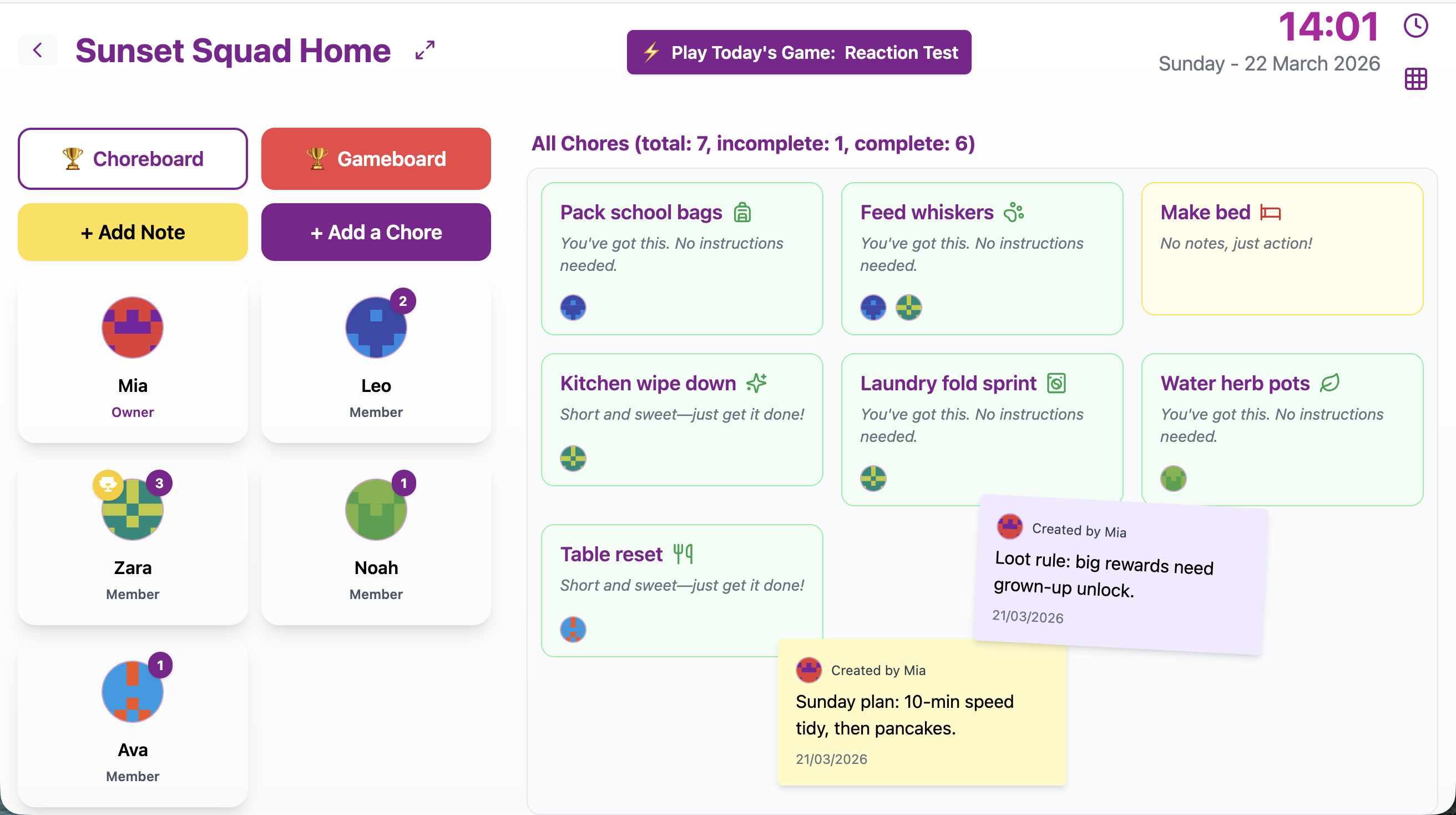
A visible dashboard helps small chores feel like part of the household rhythm, not invisible effort.
This is one reason families like using a shared choreboard or a simple visible list. A paper chart, whiteboard, fridge list, or tablet can all work. The important part is that progress is not trapped in one adult’s head.
On Chorish, family members can tap chores done, see avatars, and check the Choreboard for lighthearted progress. But the principle works anywhere: when a small win is visible, it feels more real.
For more on reducing reminders by making chores easier to see, read Making Chores Visible Without Nagging.
Tiny chores are great for younger helpers
Younger children often want to help before they are ready for bigger household jobs. This is both adorable and occasionally inefficient. A preschooler “folding laundry” may create something that looks like fabric origami after a mild storm.
That is fine.
Small chores give children a safe, simple way to join in:
- Put napkins on the table.
- Match socks by colour.
- Put toys in a basket.
- Carry a light item to another room.
- Help water a plant.
- Feed a pet with adult supervision.
The goal is not perfect execution. The goal is participation, confidence, and the idea that everyone can contribute.
Older kids and teens can still benefit from tiny chores too, especially during busy weeks. A two-minute job before homework or screens is less likely to cause resistance than a vague instruction to “help more.” If you want age-aware ideas, our guide to age-appropriate chores for kids has practical examples by stage.
Small does not mean optional
There is one important trap: if small chores are treated as silly extras, they lose their power.
A two-minute chore should be light, but it should still count. That means the household needs to treat it as a real contribution, not a pretend job given to keep someone busy.
Useful small chores have three qualities:
- They are specific. “Put shoes on the rack” beats “sort your stuff.”
- They have a visible end. Everyone can see when it is done.
- They help the household. Even a tiny job should make life a little easier.
Avoid creating fake chores just for the sake of points. Children are excellent detectors of nonsense. If the job does not matter at all, it will not build the same sense of contribution.
Instead, look for the real friction points in your home. Where do things pile up? What is always almost done but not quite? Which tiny tasks would make the next part of the day smoother?
Those are your two-minute chore candidates.
Use the Choreboard as a weekly story, not a daily punishment
Visible progress can be motivating, especially when it feels playful. A gold medal, avatar, or scoreboard can turn household help into something children actually want to check.
The trick is to keep it kind.
The Choreboard should tell a weekly story of effort, not become a courtroom exhibit titled Why Your Brother Is Winning. Use it to notice progress, not to shame anyone.
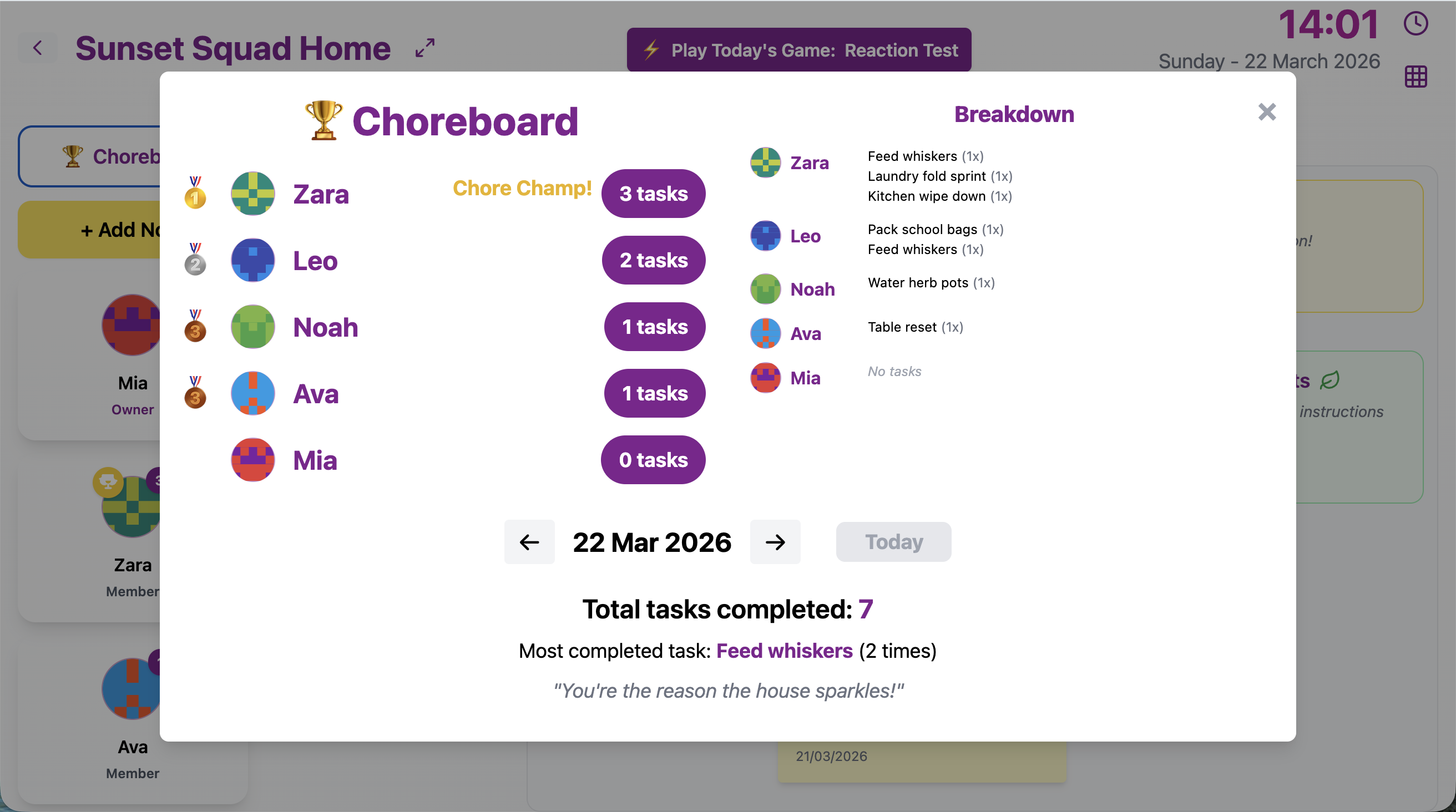
A friendly Choreboard can make small wins visible without turning every chore into a lecture.
Try saying:
- “You got three quick wins today.”
- “That little job moved you up.”
- “The board shows the kitchen is nearly reset.”
- “Nice, everyone has helped a bit this week.”
Try avoiding:
- “Why are you behind?”
- “Your sister has done more.”
- “You only did one tiny thing.”
One tiny thing may be exactly how a better habit starts.
For a deeper look at the difference between static charts and visible progress, see Chore Charts vs. a Live Scoreboard.
Pair small chores with small breaks
Two-minute chores also pair well with short breaks. Finish a tiny job, then take a breather. This rhythm is especially helpful when the household has several tasks to get through but everyone is low on energy.
For example:
- Pick one quick chore.
- Mark it done.
- Take a tiny break.
- Come back for one more if the energy is there.
The break should not swallow the afternoon whole. That is how “one quick pause” becomes “we are now watching videos about unusually confident ducks.” But a short reset can make chores feel less endless.
Chorish includes rotating daily mini-games, which some families use as a playful pause after a completed task. Our post on why a quick game after a chore is a break, not a distraction explains how to keep that rhythm light.
A simple two-minute chore experiment
If your family is in a chore rut, try this for one week.
Choose five tiny chores:
- Clear your plate.
- Put shoes away.
- Wipe the table.
- Empty lunchbox.
- Put dirty clothes in the basket.
Put them somewhere visible. Ask each person to do one quick win at a predictable time, such as before screens, after dinner, or before bed.
Then keep the tone gentle:
- Count effort.
- Notice small wins.
- Do not demand perfection.
- Keep the list short.
- Review what worked after a few days.
If a chore causes friction, shrink it. “Tidy your room” becomes “laundry in the basket.” “Clean the kitchen” becomes “wipe the table.” “Help downstairs” becomes “put the cushions back.”
Small is not failure. Small is how routines survive busy weeks.
The little jobs are the habit
It is tempting to think family responsibility is built through big weekend clean-ups and dramatic resets. Sometimes those are needed. But the quieter truth is that household habits are usually built in tiny repetitions.
The cup moved. The shoes went away. The table got wiped. The plant got watered before it started to droop.
Each small job says, “I am part of this home, and I can help care for it.”
That is why a two-minute chore still counts.
If you want a simple way to make those small wins visible, try Chorish. It is free, no sign-up, and designed for families who want chores to feel a little less like nagging and a little more like shared progress. You can also check the FAQ if you want to see how it works before setting up your household.