
A new school year, a new routine, or a quiet Tuesday afternoon is a perfectly good time to reset who does what at home.
The tricky part is choosing chores that actually fit the child in front of you. Too easy, and the job feels like busywork. Too hard, and everyone ends up frustrated while a half-folded towel slowly becomes modern art on the sofa.
Age-appropriate chores are not about squeezing productivity out of children. They are about helping kids build confidence, notice what a household needs, and practise being part of a team. The right chore says, “You can help here.” The wrong chore says, “Please begin this impossible task while everyone gets annoyed.”
This guide gives you practical chore ideas by age, simple ways to make a family chore tracker stick, and a few common mistakes to avoid. Use it as a starting point, then adjust for your child’s energy, ability, attention span, and your actual home. You know your household best.
Why age-appropriate chores matter
Children are more likely to pitch in when the job feels possible.
That does not mean every chore needs to be fun. Nobody is pretending the dishwasher is a theme park. But a job should be clear enough to understand, safe enough to attempt, and short enough that a child can experience the satisfaction of finishing it.
Age-appropriate chores help with:
- Confidence: Kids get to feel genuinely useful.
- Safety: Jobs match what a child can manage with the right level of supervision.
- Fairness: Younger children are not compared with older siblings.
- Consistency: Smaller, clearer chores are easier to repeat.
- Less nagging: A visible list removes some of the “What am I meant to do?” fog.
The aim is not perfect execution. A six-year-old setting the table may create an avant-garde fork arrangement. That is fine. The early goal is participation and habit-building, not hotel-level housekeeping.
For a calmer start, it helps to introduce chores without making them feel like a punishment. Our guide to introducing chores without a family fight has more on the tone and timing side of things.
A quick note before the age list
The ages below are gentle examples, not rules.
Children develop at different speeds. Some kids love practical jobs early; others need smaller steps, visual reminders, or more help. Some chores also depend on your home, pets, tools, layout, and safety rules. Use your judgment, supervise where needed, and skip anything that does not feel right for your child.
If a chore causes repeated frustration, shrink it. “Clean your room” might become “put dirty clothes in the basket.” “Help with dinner” might become “put napkins on the table.” Smaller is not failure. Smaller is often how the habit starts.
Chore ideas by age
Here is a practical starting point for age-appropriate chores by child age.
| Age/stage | Chore ideas | What helps it stick |
|---|---|---|
| Preschool | Put toys in a basket, match socks, wipe a small spill, place napkins on the table | One-step jobs, pictures, big praise, doing it together |
| Ages 5-7 | Clear plate, put shoes away, water plants, sort recycling, set part of the table, put books back | Short routines, visible list, simple icons, same time each day |
| Ages 8-10 | Load safe dishwasher items, fold simple laundry, wipe counters, pack school bag, take recycling out with guidance | Clear definition of “done”, choice between jobs, light scoreboard feedback |
| Ages 11-13 | Take bins out, manage a pet routine, prepare a simple snack area, vacuum one room, help reset the kitchen | Ownership, rotation, fewer reminders, chance to suggest tasks |
| Teens | Laundry cycle, bathroom reset, cook a simple meal, mow or garden where appropriate, manage a weekly household responsibility | Trust, flexibility, shared expectations, respect for busy schedules |
This list is deliberately ordinary. Ordinary chores are the ones that keep a home moving. The magic is not in inventing a perfect chart; it is in choosing jobs that are clear enough to repeat.
Preschool chores: tiny jobs with big praise
For preschoolers, chores should feel like joining in rather than being assigned a serious responsibility. Good options include:
- Putting toys in a basket.
- Matching socks by colour.
- Wiping a low table with a damp cloth.
- Carrying napkins to the table.
- Helping water one plant.
Keep the instruction short. “Blocks in the basket” is better than “tidy this room.” Praise should be specific:
- “You put all the blocks in. That helped.”
- “The table is ready because you brought the napkins.”
- “Nice matching. Those socks found their friend.”
Will the job be done perfectly? Almost certainly not. The point is that helping becomes familiar.
Ages 5-7: clear finish lines
Early elementary children often do well with chores that have an obvious ending.
Useful examples:
- Clear plate after meals.
- Put shoes and coat where they belong.
- Water plants.
- Put books back on a shelf.
- Sort recycling into the right spot.
- Set forks, napkins, or cups on the table.
At this age, a visible chore list matters. If the list lives only in a parent’s head, the child has to wait for instructions. If the list is on a wall, fridge, whiteboard, or shared tablet, they can start learning to check what comes next.
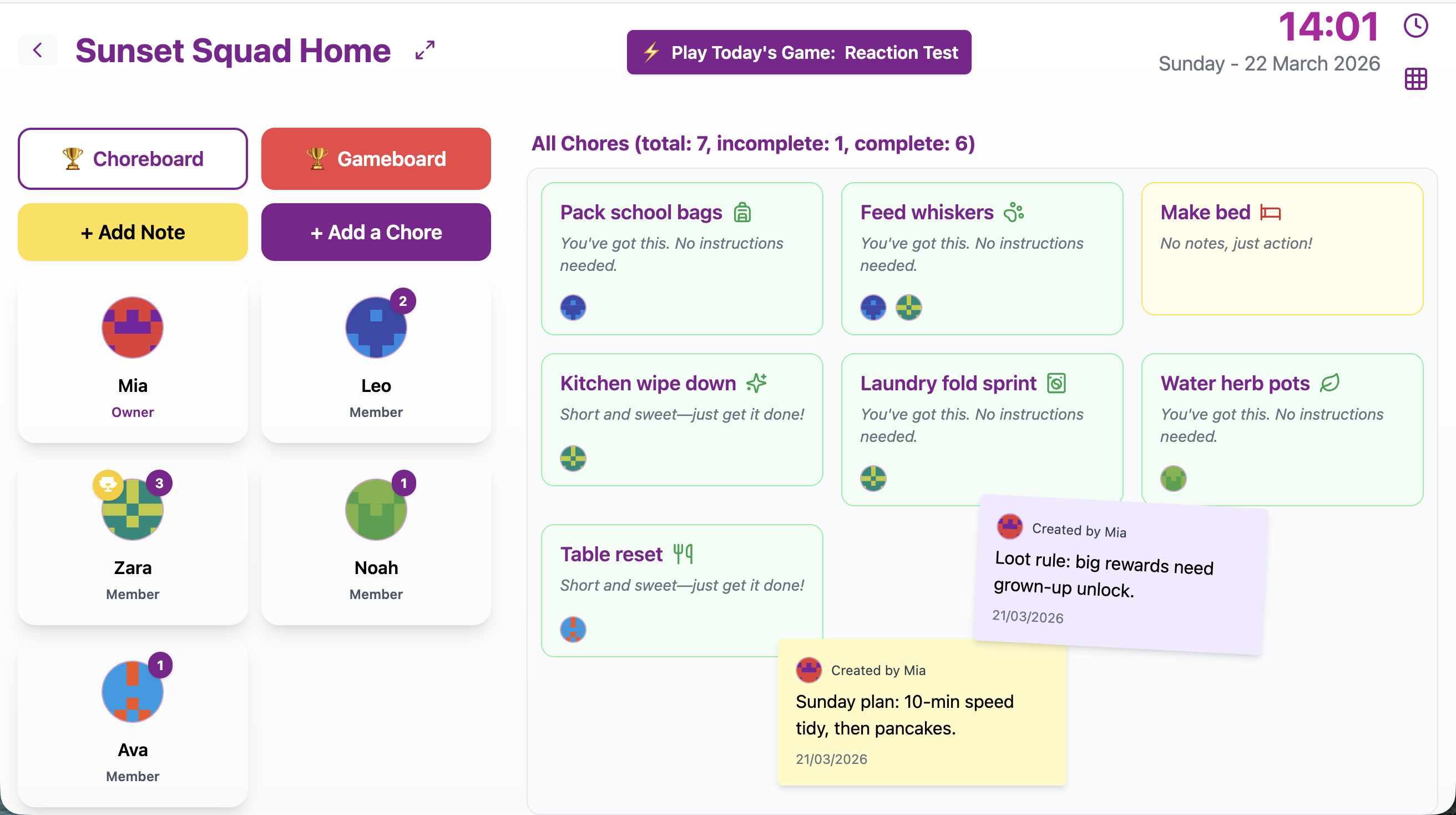
A single home screen everyone can see beats a hidden list on one phone.
Try using simple phrases:
- “Check the board.”
- “Pick one quick win.”
- “What job has your icon?”
- “Tap it done when you finish.”
The more visible the next step is, the less you have to repeat yourself.
Ages 8-10: more independence, still plenty of clarity
By ages 8-10, many children can handle multi-step chores if the finish line is clear. Good options might include:
- Load safe dishwasher items.
- Fold towels or simple clothes.
- Wipe kitchen counters.
- Pack school bag.
- Empty lunchbox.
- Take recycling to the correct bin.
- Help with a simple pet routine.
This is also a good age to offer choice. “Pick one kitchen job and one hallway job” or “Would you rather fold towels or wipe the table?” gives children a little ownership without removing the expectation that everyone helps.
Tweens and teens: ownership without the lecture
Older kids and teens usually need fewer tiny steps, but they still need clear expectations. Useful chores can include:
- Taking bins out.
- Vacuuming one room.
- Managing their own laundry cycle.
- Cleaning a bathroom sink or mirror.
- Preparing a simple meal or snack area.
- Keeping school or sports gear organised.
- Handling a pet routine with agreed rules.
The big shift here is ownership. Older kids are more likely to cooperate when they have some say in the system:
- Which chores feel fair?
- Which days are realistic?
- What needs to happen before screens or going out?
- What should count as “done”?
Try not to turn every chore conversation into a character review. “The bathroom sink needs resetting before bedtime” lands better than “You never notice anything around here.”
For fairness questions, a shared visible record can help reduce the classic “I did more!” debate. Our post on chore charts vs. a live scoreboard explores that in more detail.
Tracker ideas that actually work
A chore tracker works when people actually see it, understand it, and use it without needing a speech every time.
That can be a paper chart. It can be a whiteboard. It can be a tablet on the kitchen counter. The format matters less than the habit around it.
Strong family chore trackers usually have five things in common:
- They live in a shared place. A list hidden on one phone is easy to ignore.
- They use clear chore names. “Wipe table” beats “help downstairs.”
- They show progress. Ticks, stickers, avatars, or scores all make effort visible.
- They stay short. Too many chores can make the system feel impossible.
- They get reviewed. If a chore is not working, adjust it instead of arguing about it forever.
When the tracker is visible, the reminder becomes less personal. “The board says the table still needs wiping” usually feels calmer than “How many times do I have to ask?”
That is why many families like a shared dashboard, fridge chart, or whiteboard. It turns “who did what?” into something everyone can see.
When a little competition helps
Kids often respond when progress is visible and light-hearted. A leaderboard with a gold medal for the week’s top helper can be motivating, as long as the tone stays kind.
Helpful scoreboard language sounds like:
- “That quick job moved you up.”
- “The board shows everyone has helped today.”
- “One more chore and the kitchen is nearly reset.”
- “Nice teamwork this week.”
If a child gets stressed by rankings, soften the focus. Celebrate teamwork, count household progress, or use the board simply as a shared record.
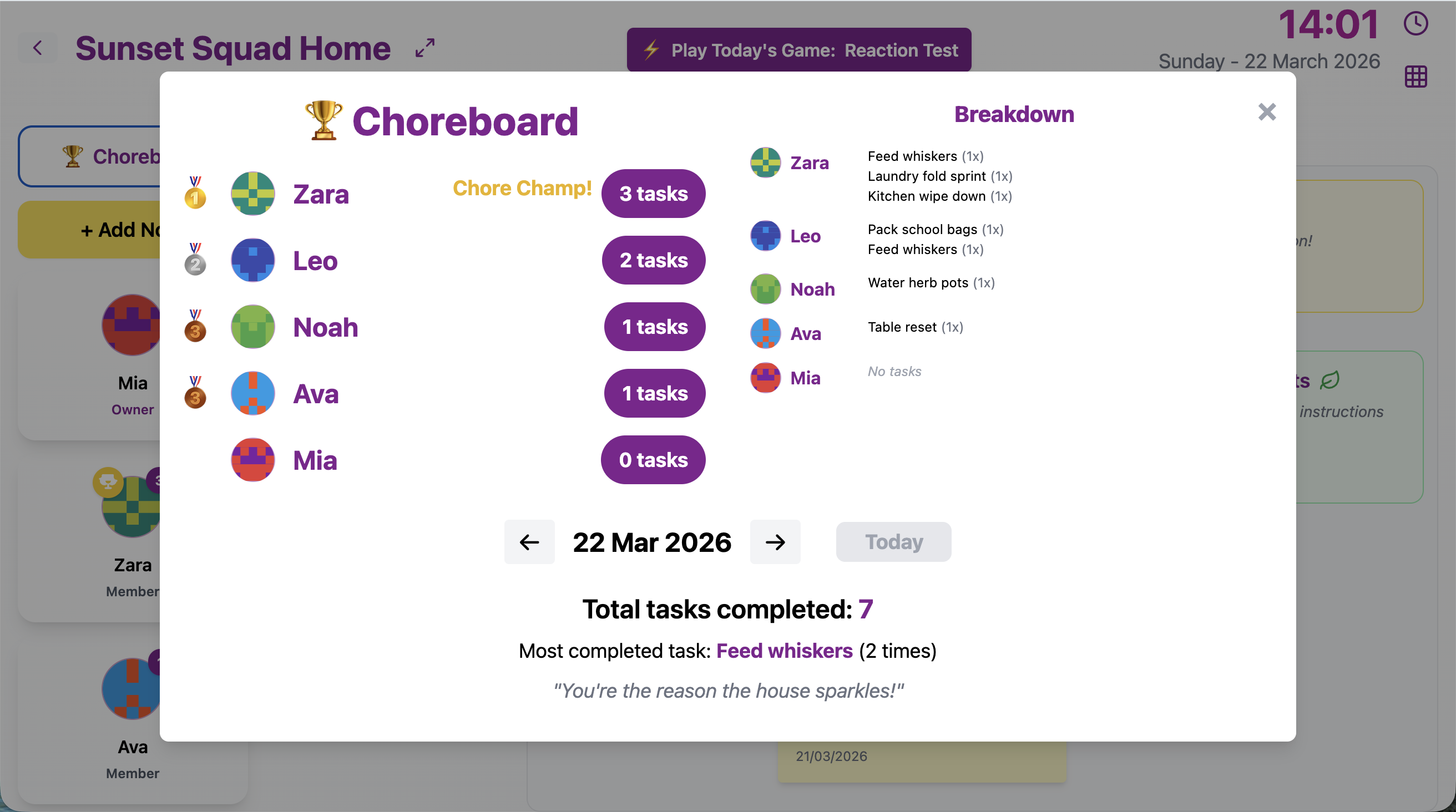
A shared scoreboard turns “who did what?” into something you can see at a glance.
Tapping a chore done (no speech required)
Little ones do not need a lecture every time they help. They need the job to feel finished.
That finish can be a sticker on paper, a tick on a whiteboard, or a tap on a shared screen. The important part is that the child sees their effort count.
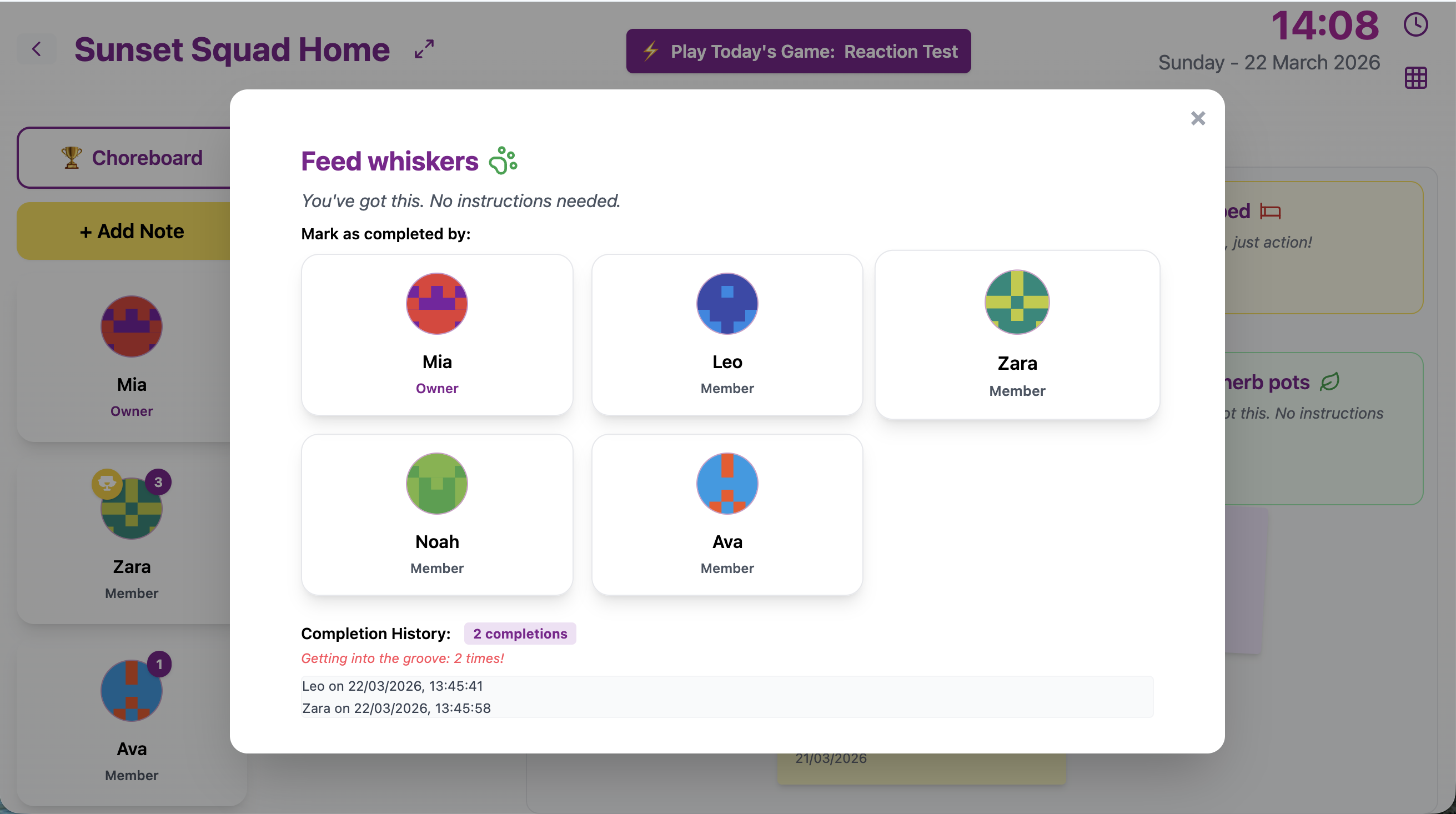
Finishing a chore is a tap away—easy for kids who already know how to tap a photo.
This is especially useful for small chores. A two-minute job can disappear if nobody notices. Marking it done makes the small win visible. Our article on why a two-minute chore still counts goes deeper on that small-wins approach.
Icons and colours that match your crew
As kids get older, they often like chores that look like theirs. Choosing an icon and colour for each task, so “dishes” gets a sparkle and “pet” gets a paw, makes the board easier to scan when life is loud.
Pictures, stickers, coloured markers, magnets, or digital icons can all work. The point is to help kids spot the right task quickly, not to make the system fancy.
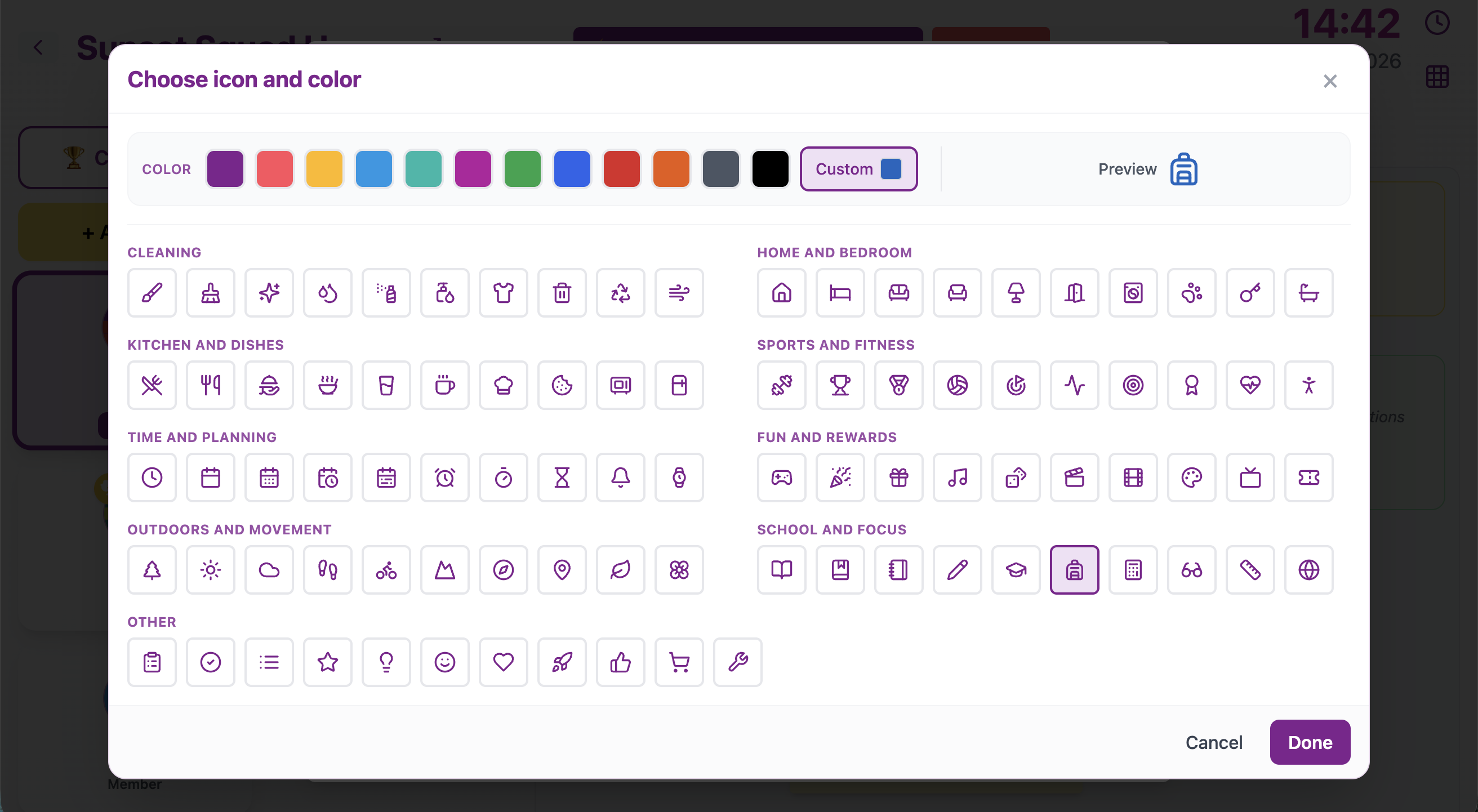
Themes and colors help everyone spot tasks at a glance—especially on a kitchen tablet.
Common mistakes to avoid
Even a good chore tracker can wobble if the system gets too heavy. Watch out for these common traps:
Making every chore too big. “Clean your room” may need to become three smaller jobs: laundry in basket, books on shelf, floor clear.
Changing the list every day. Some flexibility is good, but children learn routines faster when the basics repeat.
Expecting adult standards immediately. A child wiping the table may miss a spot. Notice the effort, then teach the next step.
Letting competition get too sharp. Friendly motivation is useful. Daily comparison and pressure are not.
Hiding the tracker. A chore chart on a parent phone may be convenient for the parent, but it does not help children learn to check the system themselves.
For more ways to reduce repeated reminders, see Making Chores Visible Without Nagging.
A simple first-week plan
If you are starting from scratch, keep the first week small.
Try this:
- Choose five chores that happen often.
- Match each chore to an age-appropriate helper.
- Put the list somewhere visible.
- Pick one routine cue, such as after dinner or before screens.
- Let children mark jobs done themselves.
- Praise effort quickly.
- Review what worked at the end of the week.
The review matters. Ask:
- Which chore was easy to remember?
- Which chore was confusing?
- Did anything feel unfair?
- Should any task be smaller?
- What should we keep next week?
That keeps the chore system alive and teaches children that household routines are something the family can improve together.
Make the tracker easy to keep using
The best tracker is the one your household will actually keep using. Paper on the fridge is great if everyone checks it. A whiteboard works well if someone updates it. A tablet can help if your family likes tapping jobs done and seeing progress at a glance.
If a visible digital tracker would help, Chorish is one free, no-sign-up option. New here? You can also check the FAQ.
Small chores, matched to the right age and made visible, can do a lot. They build confidence. They reduce reminders. They turn “someone should do that” into “I can help with this.” That is the habit worth building.