“One chore before screens” sounds almost too simple.
No complex reward chart. No family meeting with a laminated agenda. No dramatic speech about responsibility delivered while holding a rogue sock.
Just one small job before the tablet, TV, games console, or whatever glowing rectangle currently has gravitational pull in your home.
That tiny rule can work surprisingly well because it uses something families already have: a natural pause point. Before screens begin, there is usually a moment of asking, reaching, negotiating, or wandering toward the remote with suspicious casualness. That moment is a perfect place to add one small helpful action.
The goal is not to turn screen time into a battleground. It is to make helping part of the rhythm of the day. One quick chore, then screens. Simple, visible, repeatable.
Here is how to make it work without turning every afternoon into a tiny courtroom drama.
Why “before screens” works as a habit cue
Habits are easier to build when they attach to something that already happens.
Most families already have screen-time moments: after school, after homework, after dinner, weekend mornings, or those slightly chaotic half-hours when everyone is tired and the sofa begins calling people by name.
Instead of inventing a brand-new chore time, use the existing moment as a cue:
Before screens, do one small chore.
That wording matters. It is clear, short, and predictable. The child does not have to wonder whether today is a chore day. The answer is simply: if screens are coming next, one helpful job happens first.
This is not about using screens as a threat. It works best when it feels like a routine, not a bribe.
Less helpful:
- “No screens until you finally start helping around here.”
- “You never do anything unless I take the tablet away.”
- “Do chores or no TV ever again.” Ambitious, but unlikely to survive Tuesday.
More helpful:
- “One quick chore before screens.”
- “Check the board, pick one.”
- “Do a two-minute job, then you can start.”
- “Screens after one helpful thing.”
The second set points to the next action. It keeps the tone calmer and makes the expectation easier to repeat.
Keep the chore genuinely small
The word “small” is doing important work here.
If “one chore before screens” secretly means “deep clean your room, organise your drawers, and emotionally reconcile with the laundry basket,” the routine will collapse quickly. A before-screens chore should usually take two to five minutes.
Good examples include:
| Moment | Small chore idea |
|---|---|
| After school | Empty lunchbox, hang bag, put shoes away |
| Before TV | Clear cups from living room, put cushions back |
| Before gaming | Take laundry to basket, clear desk, water one plant |
| Before tablet time | Wipe table, put books away, feed pet with help |
| Weekend morning | Put breakfast dishes by sink, reset sofa, sort recycling |
The job should be easy to start and easy to finish. A child should be able to tell when it is done without needing a debate about standards.
“Tidy the living room” is vague. “Put the cushions back and move cups to the kitchen” is clearer.
“Clean your room” is huge. “Put dirty clothes in the basket” is doable.
If your family is still building the habit, choose chores that are almost too easy. You can always grow the routine later. A tiny habit that happens most days is more useful than a heroic system everyone abandons by Thursday.
For more small-job examples, our article on why a two-minute chore still counts goes deeper on quick wins and momentum.
Make the next chore visible
“Go find something helpful to do” sounds flexible, but it often creates friction.
Some children will genuinely not know what counts. Others will choose a suspiciously invisible task, such as “I thought about tidying.” Some will begin negotiating, because if the job is unclear, the rules are up for debate.
A visible list helps.
That list can be:
- A paper chart on the fridge.
- A small whiteboard.
- A sticky note with three options.
- A family tablet on the counter.
- A digital chore board everyone can see.
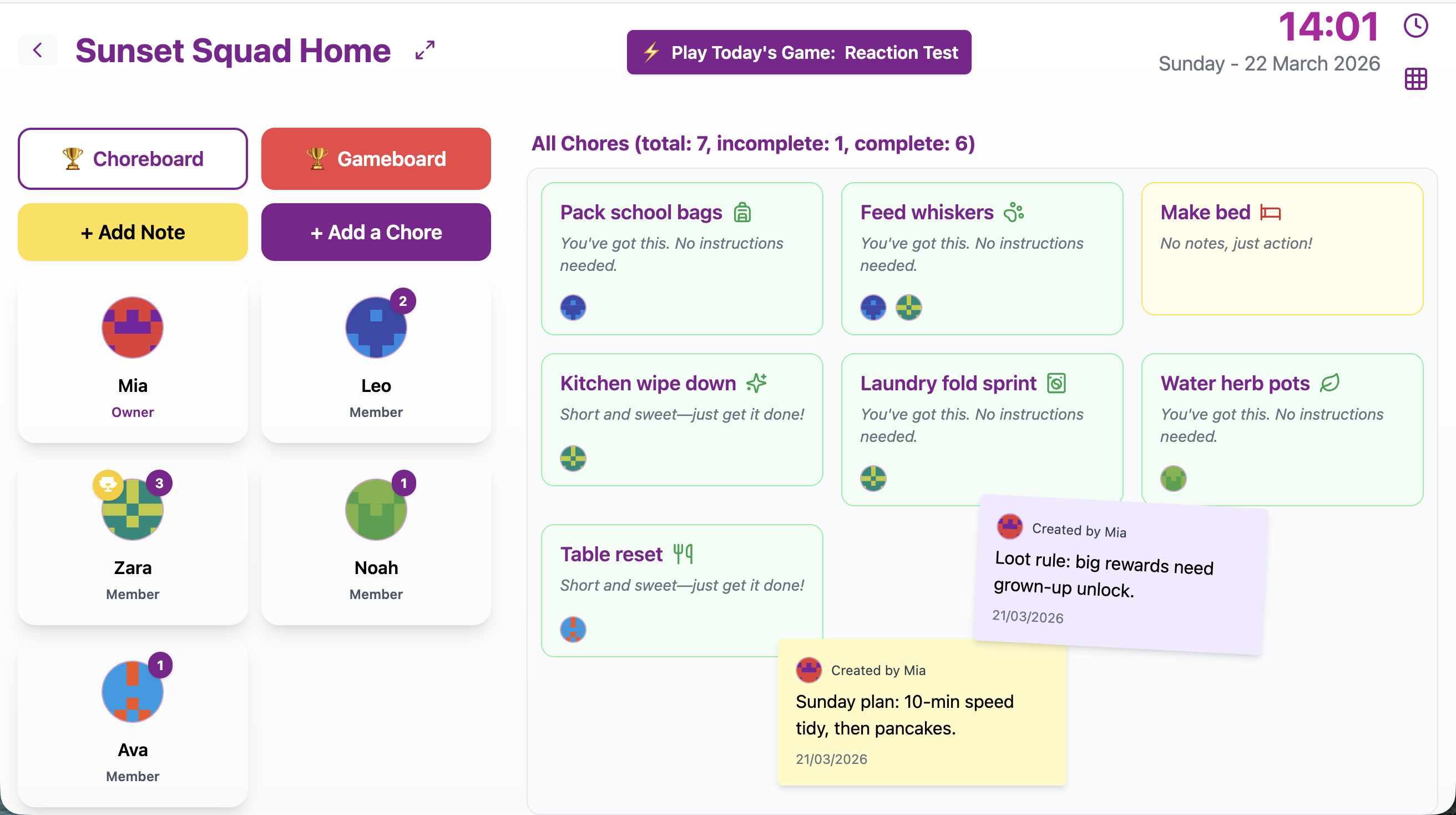
A visible list makes “one chore before screens” easier to follow without a long explanation.
The list does not need to be fancy. In fact, shorter is usually better. Try keeping a small “before screens” section with three to five quick jobs:
- Clear cups.
- Shoes away.
- Lunchbox emptied.
- Table wiped.
- Laundry in basket.
When the next action is visible, the parent can say “pick one from the list” instead of inventing a fresh instruction every time. That small shift reduces nagging because the system does some of the reminding.
Our guide to making chores visible without nagging has more ideas for making the list part of the room rather than part of one parent’s mental load.
Let the child choose when possible
Choice helps the routine feel less like an order and more like participation.
The boundary stays firm: one chore before screens. The choice sits inside that boundary: which chore?
Try:
- “Pick one from the board.”
- “Would you rather clear cups or put shoes away?”
- “Choose a kitchen job or a hallway job.”
- “Do you want the quick table wipe or the lunchbox reset?”
This is especially useful for children who resist being told exactly what to do. You are not giving up the expectation. You are giving them a little control over how they meet it.
Choice also helps with age and ability. A younger child might choose the toy basket. An older child might choose the dishwasher. A tired child might choose the smallest useful job. That is still better than no job at all.
If you are matching chores to different ages, our age-appropriate chores guide has practical examples by stage.
Mark it done immediately
The best part of a tiny chore is the finish.
Do not let that finish disappear.
When a child completes a small job, give them a way to mark it done right away. That might be a tick on a chart, a sticker, moving a magnet, or tapping a task on a shared screen. The action says, “That counted.”
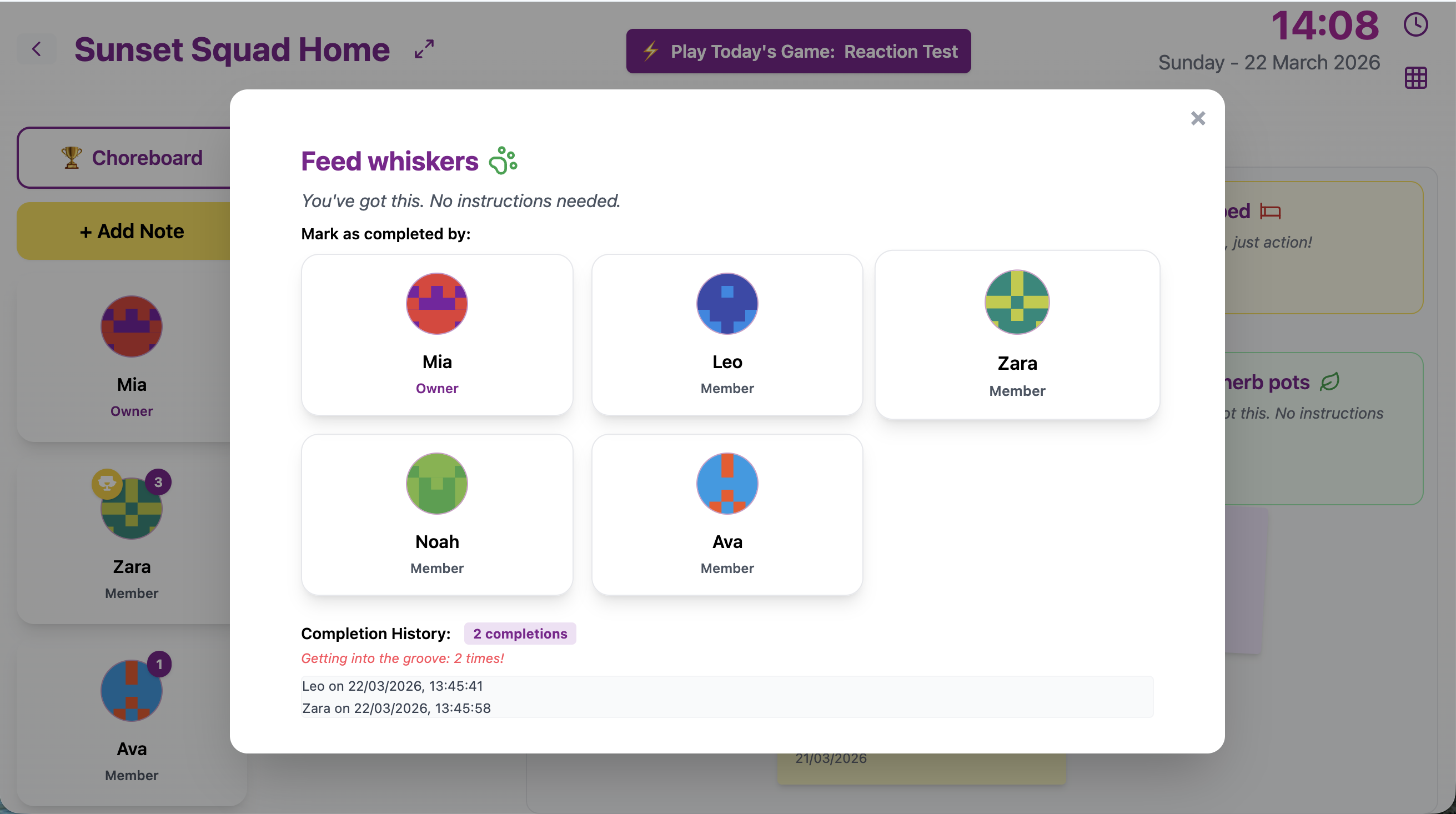
A clear completion step helps a small job feel finished.
This is one reason visible trackers can be useful for children. They create a short loop:
- See the job.
- Do the job.
- Mark it done.
- Start screens.
That loop is easier to repeat than a vague reminder floating around the room. It also gives parents a calmer phrase: “Mark it done, then start.”
Keep praise small too
Praise does not need to be enormous.
If every cleared plate gets a standing ovation, the whole routine may start to feel odd. But small, specific recognition helps children connect their action with the household benefit.
Try:
- “Thanks, that cleared the table.”
- “Nice quick win.”
- “That helped the hallway.”
- “Good reset before screens.”
- “You picked a job and finished it.”
The tone is warm but not overblown. You are noticing effort without turning the chore into a grand performance.
Avoid praise that compares siblings:
- “Finally, you did more than your brother.”
- “Why can’t you do that every time?”
- “See, that was not so hard.”
Those phrases may be understandable on a tired day, but they add pressure. The goal is to make the habit easy to repeat, not to attach a lecture to it.
What if they refuse?
Some days, a child will resist. This does not mean the routine has failed. It means you are living with humans, not tiny productivity robots.
When refusal happens, keep the response boring and consistent.
You might say:
- “Screens start after one small chore.”
- “You can choose the job, or I can choose one.”
- “We can wait. The rule is the same.”
- “Pick the smallest one if you are tired.”
Try not to escalate into a long argument. The more emotional the routine becomes, the less likely it is to stick.
It can also help to check whether the chore is too big. If a child melts down every time “tidy your room” appears before screens, the task may need shrinking. Try “laundry in basket” or “books on shelf” instead.
Small enough to start is the secret.
How to avoid making screens the villain
The wording matters here.
This routine works best when screens are not framed as the enemy. Screens are part of modern family life. The aim is not “chores because screens are bad.” The aim is “help first, then enjoy your break.”
That distinction keeps the tone healthier.
Better framing:
- “We help the house before we switch off.”
- “One job, then your show.”
- “Quick reset before game time.”
- “Screens after a helpful thing.”
This avoids turning chores into a punishment for wanting to relax. It also avoids turning screen time into a forbidden treasure that becomes even more exciting because everyone is arguing about it.
Make it a household rhythm, not a kid-only rule
Children notice when rules only apply to them.
If possible, make “one helpful thing before screens” part of the household culture. Adults can model it too:
- Put cups in the dishwasher before watching TV.
- Fold one small laundry pile before scrolling.
- Clear the coffee table before a film.
- Reset the kitchen before opening a laptop for the evening.
You do not need to announce this dramatically. Just let children see that everyone contributes before switching into rest mode.
This is especially useful in shared spaces. If the living room is about to become the screen room, one quick reset helps everyone enjoy it more.
Use friendly progress, not pressure
Some families like adding a scoreboard element. Others prefer a calm checklist. Both can work.
For older kids, seeing progress build over the week can be motivating. A visible record answers the question “did I help?” without relying on memory. It can also reduce fairness arguments because everyone can see what has been completed.
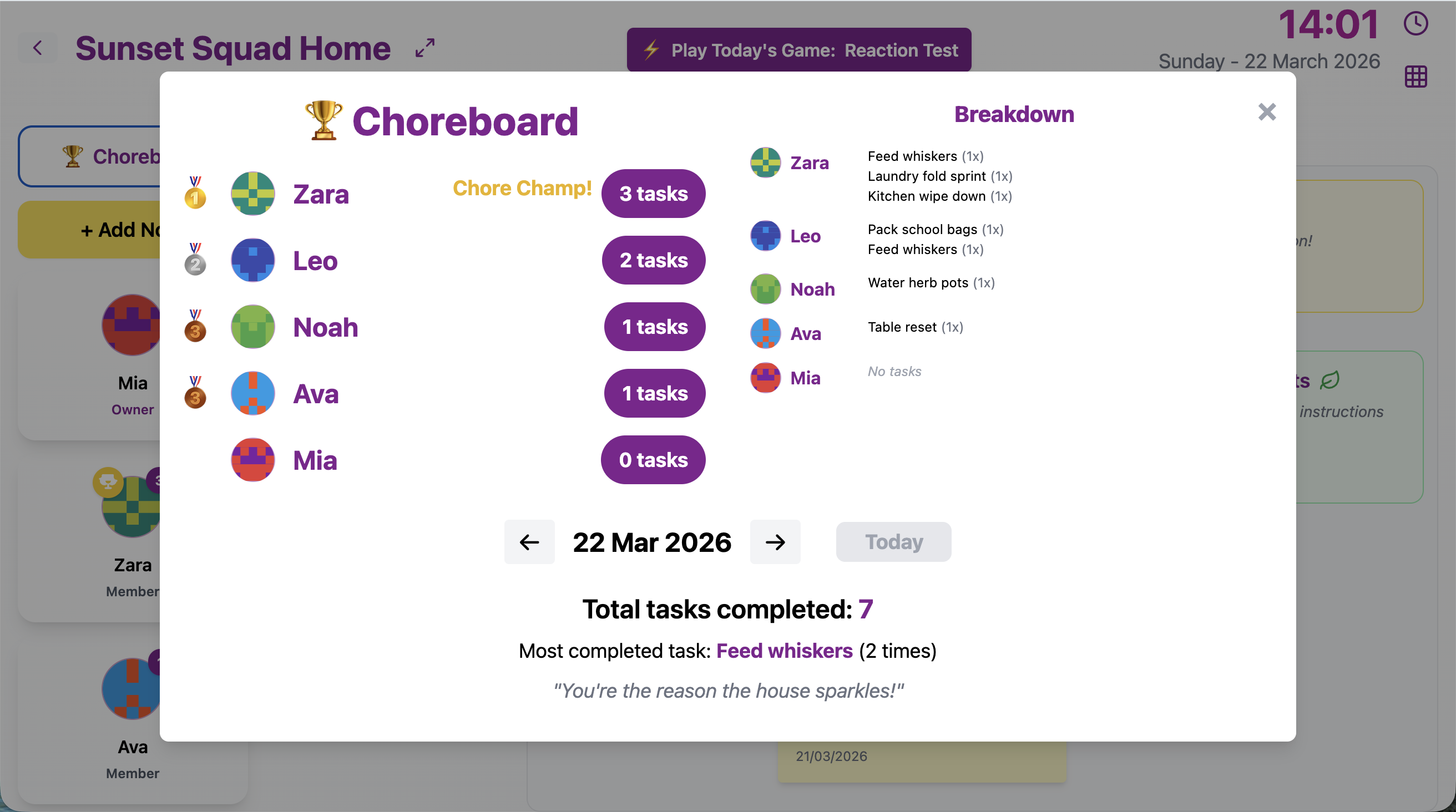
Visible progress can be motivating when the tone stays light.
Keep competition gentle. A board should celebrate effort, not rank children’s worth by sock management.
Helpful phrases:
- “You added another quick win.”
- “The board shows the kitchen is nearly done.”
- “Nice, everyone has helped today.”
If competition causes stress, remove the competitive framing and use the board as a shared record instead.
A simple one-week experiment
Try this for one week:
- Choose one screen-time moment, such as after school or after dinner.
- Pick five tiny chores that take two to five minutes.
- Put the list somewhere visible.
- Use one consistent phrase: “One small chore before screens.”
- Let the child choose from the list when possible.
- Mark the chore done immediately.
- Keep praise short and specific.
- Review what worked at the end of the week.
At the review, ask:
- Which chore was easiest to start?
- Which chore felt annoying?
- Was the list visible enough?
- Did the rule feel clear?
- Should any chore be smaller?
Adjust the system instead of abandoning it. Good routines are rarely perfect on the first try. They get better because the family notices what actually happens.
The point is momentum
One small chore before screens will not solve every household problem. It will not fold the entire laundry mountain, teach lifelong responsibility overnight, or prevent someone from leaving a spoon in an unexpected location.
But it can create a useful rhythm.
Help first. Mark it done. Enjoy the break.
That rhythm teaches children that chores are not giant punishments waiting at the end of the day. They are small acts of care that can fit into ordinary life.
If a visible digital tracker would help your household, Chorish is one free, no-sign-up option. A paper chart or whiteboard can work too. The real win is choosing a simple system your family can see, repeat, and keep kind.